Mantifangアーカイブとの関連
KoiTalk gives practical koi guidance. For the wider cultural archive behind water, Korea, ceramics, gardens and Mantifang’s older koi material, visit Mantifang.
Koi variety guide
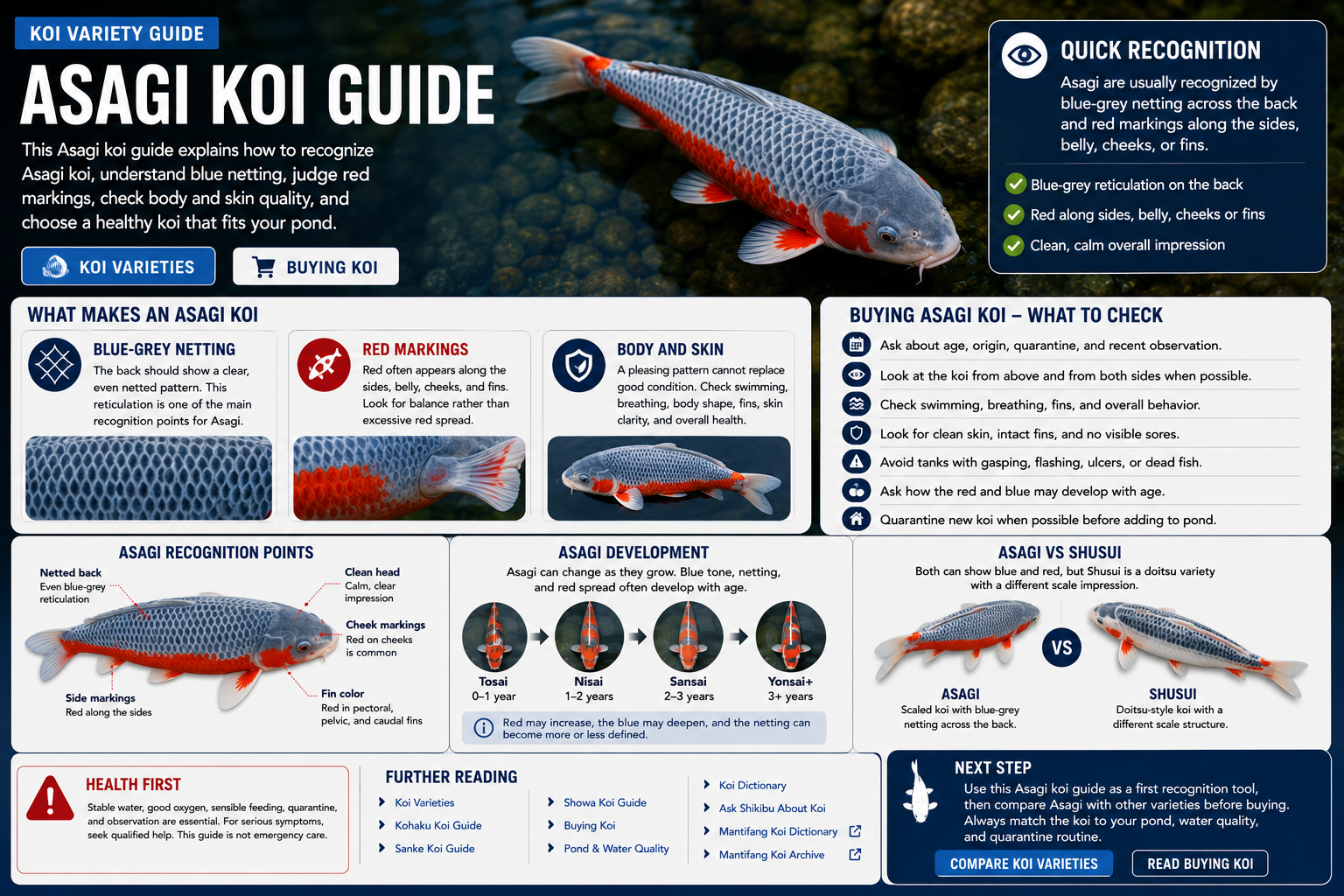
Asagi Koi Guide
This Asagi koi guide explains how to recognize Asagi koi, understand blue-grey netting, judge red markings, check body and skin quality, and choose a healthy koi that fits your pond.
What Makes an Asagi Koi
Asagi koi are one of the older and more traditional koi varieties. Instead of bold red-white-black pattern drama, Asagi appreciation often depends on calm balance, clean blue netting, controlled red placement, healthy skin, and good body shape.
Blue-Grey Netting
The back should show a clear, even netted pattern. This reticulation is one of the main recognition points for Asagi.
Red Markings
Red often appears along the sides, belly, cheeks, and fins. Beginners should look for balance rather than excessive red spread.
Body and Skin
A pleasing pattern cannot replace good condition. Check swimming, breathing, body shape, fins, skin clarity, and overall health before buying.
Asagi Koi Guide for Beginners
This guide keeps the first judgement practical. Do not buy Asagi koi only because the blue looks unusual in a photo. Look at the fish in water, compare both sides, ask about age and development, and make sure the koi fits your pond.
- Confirm the VarietyLook for blue-grey netting over the back with red placed along the sides, belly, cheeks, or fins.
- Check the NettingThe reticulation should appear clear, calm, and reasonably even across the back.
- Watch the RedRed should support the fish visually and not overwhelm the blue ground.
- Judge Health FirstCheck body shape, skin quality, fins, swimming, breathing, appetite, and pond fit.
How to Recognize Asagi Koi
Asagi koi recognition is different from Kohaku, Sanke, and Showa. Instead of reading large pattern plates, the keeper reads the blue back, scale netting, red placement, head impression, and overall calmness of the fish.
Netted Back
The back should show the classic blue-grey scale pattern. Uneven or muddy netting can weaken the overall impression.
Clean Head
A clean head impression helps the fish look calm and refined. Beginners should avoid judging from one photograph only.
Red Placement
Red on the sides, belly, cheeks, or fins should feel controlled. Too much red can make the fish look heavy or unbalanced.
Buying Asagi Koi
Buying Asagi koi should be done slowly. Blue and red can look attractive, but long-term value depends on health, skin, body shape, clean netting, seller transparency, water quality, and whether the fish fits your pond.
- Ask about age, origin, quarantine, and recent observation.
- Look at the koi from above and from both sides when possible.
- Check whether the fish swims steadily and breathes normally.
- Look for clear skin, intact fins, and no visible sores.
- Avoid koi from tanks with gasping, flashing, ulcers, or dead fish.
- Ask how the red and blue may develop with age.
- Quarantine new koi when possible before adding them to the main pond.
Useful Tools Before Buying Asagi
Product guidance should support careful observation, safe handling, quarantine, and water testing. It should not replace judgement about fish health, development, or pond readiness.
Before buying an Asagi, make sure you can test your water, observe the fish safely, and prepare quarantine if possible.
Asagi Development and Pattern Balance
Asagi can change as they grow. Red may spread, the blue ground may deepen, and the netting can become more or less pleasing. This is why the whole fish matters more than one attractive detail.
Blue Ground
The blue-grey ground should support the traditional Asagi impression. Very dark or muddy color can reduce clarity.
Reticulation
The scale netting should feel orderly. It does not need to be perfect, but it should not look confused or broken across the back.
Red Spread
Red can increase with age. Ask what is expected and what remains uncertain before paying for imagined future quality.
Asagi, Shusui, and Other Varieties
Asagi is often compared with Shusui because both can show blue and red, but Shusui is a doitsu variety with a different scale impression. Beginners should compare scale structure, back pattern, and body impression carefully.
Asagi
Scaled koi with blue-grey netting across the back and red along the sides, belly, cheeks, or fins.
Shusui
Doitsu-style koi related to Asagi, often with blue and red but a different scale structure along the back.
Go-Sanke Difference
Kohaku, Sanke, and Showa are read through large red, white, and black pattern structures. Asagi is read more through netting, tone, and balance.
Asagi Health and Pond Fit
An Asagi with beautiful blue netting still needs stable water, good oxygen, sensible feeding, quarantine, and careful observation. If a koi shows ulcers, gasping, heavy flashing, clamped fins, isolation, or sudden decline, test the water immediately and ask an experienced koi professional or qualified aquatic veterinarian for help.
Q&A: Asagi Koi Guide
What is an Asagi koi?
An Asagi koi is a traditional koi variety known for blue-grey netting across the back and red markings along the sides, belly, cheeks, or fins.
How do I recognize Asagi koi?
Look for blue-grey reticulation over the back, controlled red placement, a clean head impression, and a calm overall balance.
Is this Asagi koi guide useful for beginners?
Yes. This Asagi koi guide gives beginners practical recognition points and explains what to check before buying.
What should I look for when buying Asagi koi?
Look at body shape, skin quality, netting, red placement, swimming, breathing, fins, seller transparency, and whether the koi fits your pond.
Does Asagi change with age?
Yes. The blue tone, netting impression, and red spread can change as the koi grows and matures.
Should I quarantine a new Asagi?
Yes, when possible. Quarantine protects the main pond and gives time to observe the koi before mixing it with other fish.
Further Reading
Use this Asagi koi guide as the practical starting point. KoiTalk explains recognition and buying basics, while Mantifang carries deeper koi dictionary and archive material.
Next Step
Use this Asagi koi guide as a first recognition tool, then compare Asagi with other varieties before buying. Always match the koi to your pond, water quality, and quarantine routine.