Mantifang archive connection
KoiTalk gives practical koi guidance. For the wider cultural archive behind water, Korea, ceramics, gardens and Mantifang’s older koi material, visit Mantifang.
Hier is de complete HTML voor Begin Here met subtiele commerciële laag:
Start with the right order
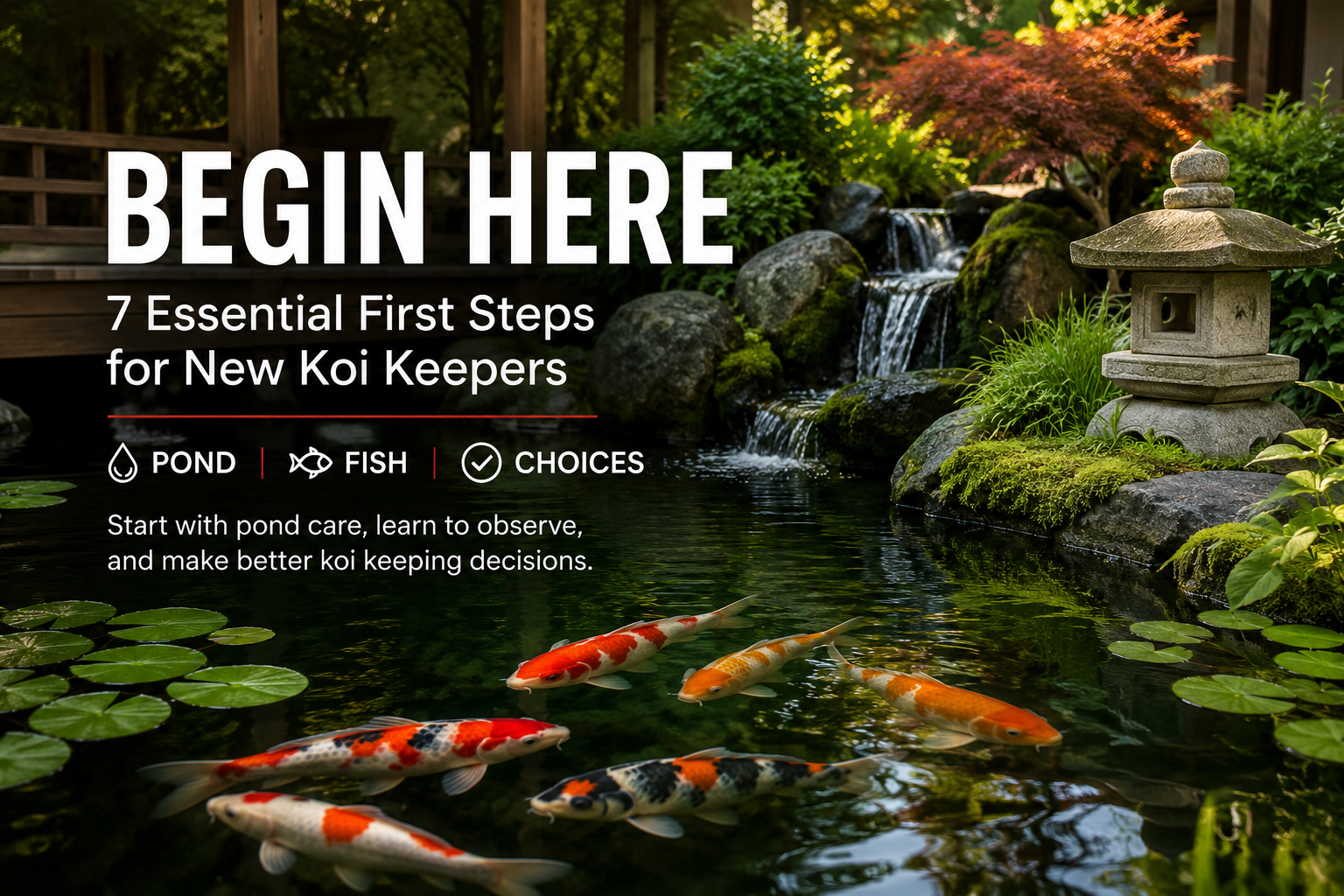
Begin Here — 7 Essential First Steps for New Koi Keepers
Begin Here is the practical starting path on Koi Talk for new koi keepers, returning pond owners, and anyone who wants to understand koi care before making expensive or risky decisions.
Good koi keeping begins before the first fish is bought. It begins with water, space, filtration, oxygen, observation, patience, and the willingness to learn what a pond is telling you.

Begin Here: The First Koi Talk Path
The first path is simple: learn the pond, learn the fish, then learn the choices. This order prevents many beginner mistakes and keeps the hobby practical.
1. Learn the Pond First
A koi pond is not just a container of water. It is a living system shaped by volume, filtration, oxygen, stocking level, temperature, maintenance, and seasonal change.
2. Learn to Test Water
Clear water is not always safe water. Important readings include ammonia, nitrite, nitrate, pH, KH, temperature, and oxygen conditions.
3. Learn to Observe Fish
Healthy observation means watching appetite, swimming, breathing, skin, fins, body posture, and social behavior. Small changes can matter.
Why Beginners Should Not Start with Buying
Many new keepers start by asking which fish to buy. That is understandable, but it is not the safest first question. The better first question is whether the pond is ready.
A strong purchase begins with preparation. You need space, stable water, suitable filtration, oxygen, quarantine awareness, and a plan for what happens after the fish arrives.
7 Essential First Steps for New Koi Keepers
Use these seven steps as your first checklist. They create the foundation for better long-term care.
Step 1: Know Your Pond Volume
Pond volume affects stocking, filtration, treatment decisions, oxygen demand, and how quickly water quality can change.
Step 2: Understand Filtration
Filtration is not only about removing visible dirt. Biological filtration helps convert harmful waste products and supports a more stable pond environment.
Step 3: Test Before You React
When something looks wrong, test the water before making random changes.
Step 4: Watch Behavior Daily
Fish behavior often changes before obvious symptoms appear. Watch feeding response, swimming rhythm, breathing, isolation, flashing, and fin position.
Step 5: Avoid Overstocking
Too many fish can overwhelm filtration and oxygen levels. A pond may look large but still be biologically limited.
Step 6: Quarantine New Fish
New arrivals can bring stress, parasites, or disease into an existing pond. Quarantine is a responsible habit.
Step 7: Buy Slowly
Buying slowly gives you time to learn what you like, what your pond can handle, and how each new fish affects the system.
Useful Equipment to Understand First
New koi keepers do not need to buy everything at once. But they should understand the basic equipment categories before making decisions.
What to Read First on Koi Talk
Use this reading path if you are new.
- Pond & Water Quality for water stability, testing, ammonia, nitrite, pH, KH, oxygen, and filtration basics.
- Beginner Guides for first steps, planning, and common beginner mistakes.
- Koi Health for observation, warning signs, quarantine, parasites, ulcers, and practical limits.
- Buying Koi for responsible purchase decisions after the pond is ready.
- Recommended Koi Products for practical koi and pond equipment guidance.
- Koi Varieties for learning Kohaku, Sanke, Showa, Asagi, and other variety conversations.
- Koi Dictionary for terminology used across the hobby.
Ask Shikibu When You Are Unsure
Ask Shikibu can help visitors ask clearer questions about pond care, water quality, health signs, variety identification, and buying choices.
For serious health concerns, severe wounds, sudden deaths, or rapid behavior changes, involve an experienced koi professional or a qualified aquatic veterinarian.
Questions and Answers
These short answers help new visitors understand how to use this page.
Where should a new koi keeper begin?
Begin with pond water quality, filtration, oxygen, and observation.
Is clear pond water always safe?
No. Clear water can still have ammonia, nitrite, unstable pH, low KH, or poor oxygen.
Should beginners buy expensive koi first?
Usually not. Beginners should first learn pond stability, quarantine, feeding, and observation.
What is the most important first habit?
Regular observation. Watch how fish swim, breathe, eat, and behave.
When should Ask Shikibu be used?
Use Ask Shikibu for clearer practical questions. For urgent health issues, seek experienced local help.
Why does Koi Talk link to Mantifang?
Koi Talk gives practical guidance. Mantifang holds deeper archive material, dictionary entries, and background pages.
Further Reading on Mantifang
Koi Talk gives the practical starting path. Mantifang offers deeper background for readers who want the longer koi library view.
Responsible Care Comes First
Koi Talk is educational. It does not replace experienced professionals, veterinarians, or careful pond-side observation.
The purpose of Begin Here is to slow the first steps down enough to make better decisions.
Continue Exploring Koi Talk
Choose the section that best matches your next question.