Mantifang archive connection
KoiTalk gives practical koi guidance. For the wider cultural archive behind water, Korea, ceramics, gardens and Mantifang’s older koi material, visit Mantifang.
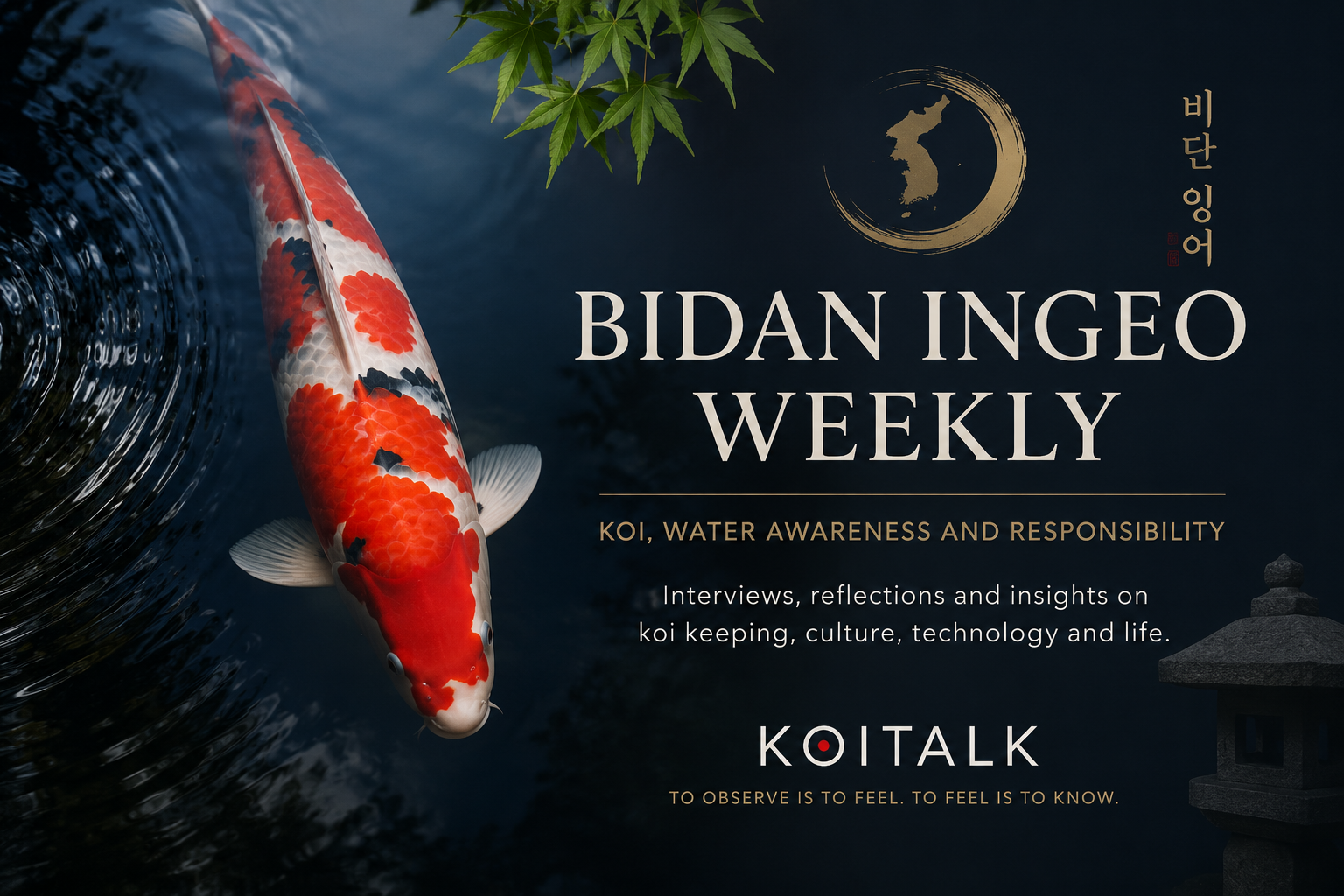
Bidan Ingeo Weekly
Bidan Ingeo Weekly — Koi, Water Awareness and Responsibility
The Weekly is KoiTalk’s reflective weekly series about koi keeping, water awareness, Korea, Japan, responsible pond care, Mantifang, and The Jijang Fractal.

Bidan Ingeo Weekly is KoiTalk’s editorial series for readers who want more than quick pond tips. It connects practical koi keeping with observation, water feeling, responsibility, culture, and the deeper human meaning of caring for living systems.
Bidan Ingeo is a Korean expression for brocade carp, closely related in meaning to Nishikigoi, the Japanese name for ornamental koi. The title connects Korean language, Japanese koi culture, and KoiTalk’s wider interest in water, observation, and responsibility.
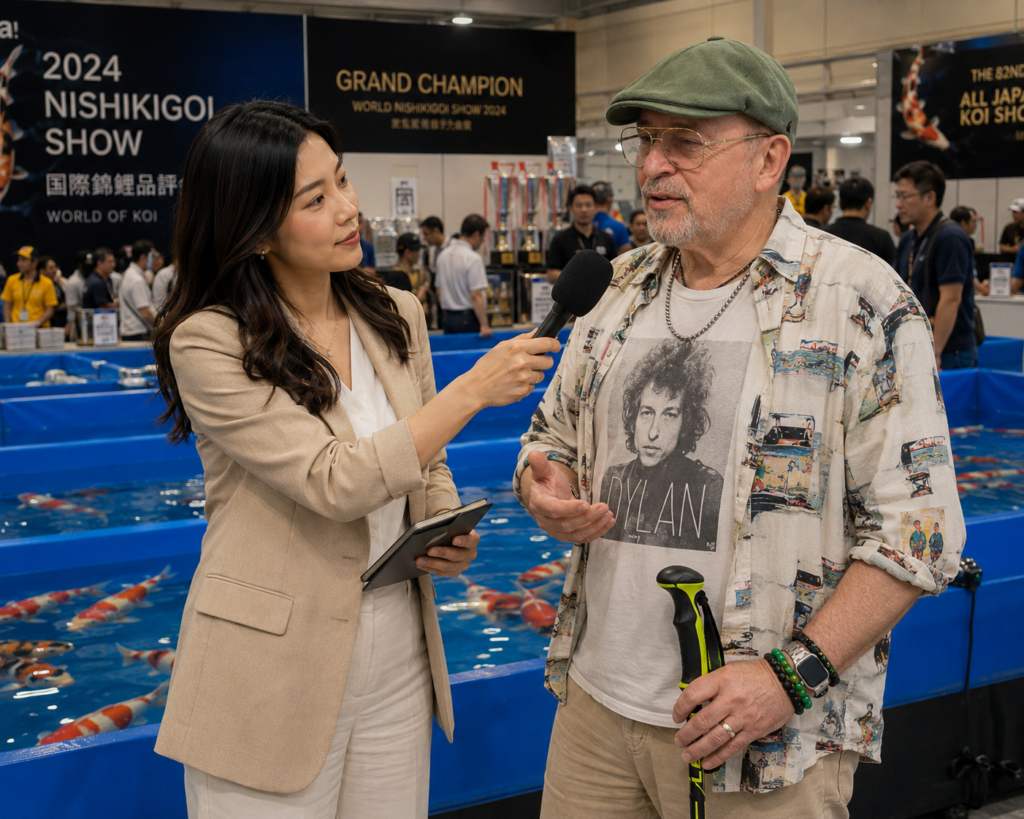
This page introduces the series and begins with Hana Min’s first conversation with Hugo J. Smal: Healthy Koi Begin With Attention.
What Is Bidan Ingeo Weekly?
It is KoiTalk’s weekly editorial series exploring koi keeping, water awareness, responsible koi keeping, Japanese koi culture, Korean koi culture, Mantifang, and The Jijang Fractal.
Each edition of combines interviews, reflections, history, pond management, water quality, and the wider cultural world surrounding Nishikigoi.
The series sits beside KoiTalk’s practical guides. Where the guides explain water testing, health, buying, varieties, and pond care, Bidan Ingeo Weekly asks what koi keeping teaches us about attention.
Why Bidan Ingeo?
The name matters because KoiTalk is not only a product or pond-care site. It connects Japanese Nishikigoi culture, European koi history, and Korean language, memory, water technology, and landscape.
Korean Language
Bidan Ingeo can be understood as brocade carp in Korean. It gives the series a Korean doorway into the world of koi.
Water and Responsibility
The series focuses on observation, water feeling, responsible care, and the human meaning of keeping a living pond.
Interview by Hana Min for Bidan Ingeo Weekly.
Hana Min speaks with Hugo J. Smal about koi keeping, water awareness, Goyang Koi Farm, Mantifang, Korea, Japan, and the quiet responsibility behind The Jijang Fractal.
Hana Min: You have been involved with koi for decades. What first attracted you to koi keeping?
Hugo J. Smal: At first, like many people, I was attracted by beauty.
Koi are extraordinary animals. They move through water in a way that naturally draws attention. But after some years I realized that koi are not really the only subject.
Water is.
A koi can only be understood through the environment in which it lives. The fish teaches you to observe the pond. The pond teaches you to observe yourself.
Hana Min: Many people think koi keeping is mainly about expensive fish and prizes. Do you agree?
Hugo J. Smal: That is one part of the hobby, but it is not the heart of it.
I have seen wonderful ponds filled with modest koi that gave their owners tremendous happiness. And I have seen expensive collections where the owner spent more time worrying than enjoying.
A koi pond is not a stock market. It is a living environment.
Koi keeping is not only for prize-winning koi or international shows. It is also for the person who comes home, sits beside the water, recognizes the fish, sees the seasons change, and learns to care for something living.
If you cannot sit quietly beside the water and simply watch, you are missing something important.
Hana Min: KoiTalk uses the phrase “To observe is to feel. To feel is to know.” What does that mean?
Hugo J. Smal: It comes from many years of looking at ponds.
Water testing is important. I encourage it. But experienced koi keepers know something else too.
Long before a test kit reveals a problem, the pond often tells you.
The fish behave differently. The water feels different. The sound of the pond changes. The rhythm changes. Something is no longer quite right.
Observation comes first. Over time, observation becomes intuition. And intuition is often simply observation accumulated over many years.
Hana Min: For many years you became better known for Mantifang, Korean culture, and writing than for koi. What happened?
Hugo J. Smal: People sometimes think I left the koi world. I do not think I ever did.
The center of gravity simply moved.
What began as an interest in koi gradually opened doors into Japanese and Korean culture, history, landscape, Buddhism, philosophy, and writing. Over time that journey led to Mantifang, my work around Korea, my friendship with people such as Kim Young Soo of Goyang Koi Farm, and eventually to The Jijang Fractal.
For many years I spent more time walking through temples, studying Korean history, writing, and building Mantifang than attending koi shows.
But the lessons of koi never disappeared.
Observation. Patience. Attention. Responsibility.
Those are lessons that work equally well beside a pond, in a temple courtyard, or at a writing desk.
Hana Min: What role did Goyang Koi Farm play in that journey?
Hugo J. Smal: Goyang Koi Farm reminded me that koi are not only a Japanese story.
Of course, Nishikigoi belong deeply to Japan. That history matters. But koi also became part of a wider Asian story and part of my Korean journey.
Through Kim Young Soo and Goyang Koi Farm, I saw how koi can connect people, landscapes, businesses, friendships, and cultural exchange.
That reinforced something I had already begun to suspect.
Koi are never just fish.
They are often a meeting place. Between people. Between countries. And sometimes between different parts of a person’s life.
Hana Min: Does this connect with The Jijang Fractal?
Hugo J. Smal: I think it does.
The Jijang Fractal is ultimately about responsibility. Not responsibility imposed from outside, but responsibility that grows naturally from attention.
When we pay attention, we notice connections. When we notice connections, we recognize consequences. When we recognize consequences, responsibility follows.
That applies to families. It applies to societies. It applies to culture. And surprisingly, it also applies to koi ponds.
A pond is a small world. Everything affects everything else. Water, oxygen, feeding, filtration, weather, stocking, patience, neglect, care — nothing stands alone.
That is why koi keeping can become more than a hobby. It can become a quiet form of ethical attention.
Hana Min: Why do Japan, Europe, and Korea all matter for KoiTalk?
Hugo J. Smal: Japan gives koi their deepest cultural and aesthetic foundation. Without Japan, there is no real understanding of Nishikigoi.
Europe gave the modern hobby much of its pond engineering, filtration development, club structure, shows, magazines, and commercial infrastructure.
Korea, for me, opens another dimension: water technology, landscape, smart systems, aquaculture, culture, and the future relationship between tradition and innovation.
KoiTalk is not only about products. It is about connecting these worlds in a responsible way.
Hana Min: What do you hope KoiTalk becomes?
Hugo J. Smal: I hope it becomes more than a website.
I hope it becomes a place where knowledge, experience, technology, history, and responsibility come together.
Not only for people who want champion koi, but also for people who simply enjoy sitting beside a pond after work.
The koi world needs both.
Hana Min: What would you say to someone building a first pond?
Hugo J. Smal: Do not start with the fish.
Start with the water.
Learn to observe. Be patient. Do not confuse buying with caring.
A pond is not something you own in the ordinary sense. It is something you are responsible for.
If you learn that lesson, the koi will teach you the rest.
About Hugo J. Smal
Hugo J. Smal is a Dutch writer, cultural observer, and founder of KoiTalk. His work connects koi keeping, water awareness, Korean culture, Japanese koi tradition, European koi history, and the philosophical project The Jijang Fractal.
Through Mantifang, he has spent many years writing about Korea, memory, culture, Buddhism, landscape, and responsibility. KoiTalk brings part of that long journey back to the water.
About Hana Min
Hana Min is the editorial voice of Weekly, asking quiet questions about koi, water, culture, technology, Korea, Japan, and responsibility.
Weekly Q&A
These short answers help readers understand the series, the Korean name, and the connection between koi keeping, water awareness, and responsibility.
What does Bidan Ingeo mean?
Bidan Ingeo is a Korean term associated with brocade carp and connects Korean language with the wider Nishikigoi tradition.
What is Bidan Ingeo Weekly?
It is KoiTalk’s editorial interview and commentary series covering koi keeping, water awareness, culture, and responsibility.
How does it relate to KoiTalk?
KoiTalk provides practical koi knowledge. The Weekly explores the wider human, cultural, and philosophical dimensions of koi keeping.
What is water awareness?
Water awareness means learning to observe water, fish behaviour, oxygen demand, seasonal changes, and pond stability before problems become visible.
How is The Jijang Fractal connected to koi keeping?
Both explore responsibility, observation, attention, and the consequences of actions within living systems.
Will the Weekly continue?
Yes. New editions will be published regularly as part of the growing KoiTalk ecosystem.
Related Mantifang and Jijang Fractal Reading
These links give deeper context for the cultural, philosophical, and Korean background behind this conversation.
Mantifang
The wider cultural archive behind Hugo J. Smal’s writing on Korea, memory, Buddhism, landscape, koi, and long-form observation.
The Jijang Fractal
The philosophical gateway for responsibility, compassion, attention, and the deeper structure behind Hugo’s current writing.
Mantifang Koi Dictionary Index
The long-maintained koi dictionary archive connected to KoiTalk’s practical koi knowledge structure.
Nishikigoi on Mantifang
A deeper terminology entry for Nishikigoi and koi language within the broader Mantifang archive.
Starting a Koi Hobby
A Mantifang background page for readers who want to connect practical koi keeping with older archive material.
Water Quality and Koi Health
Mantifang’s longer water-quality background supporting KoiTalk’s focus on observation, testing, and responsible care.
Further Reading on KoiTalk
Use these KoiTalk pages to continue exploring koi keeping, water quality, responsibility, and the practical side of this philosophy.
Future Issues of the Weekly
Future editions of the Weekly will appear as individual posts, while this page remains the central landing page for the series.