Verbonden met het Mantifang-archief
KoiTalk gives practical koi guidance. For the wider cultural archive behind water, Korea, ceramics, gardens and Mantifang’s older koi material, visit Mantifang.
Personal pond vision
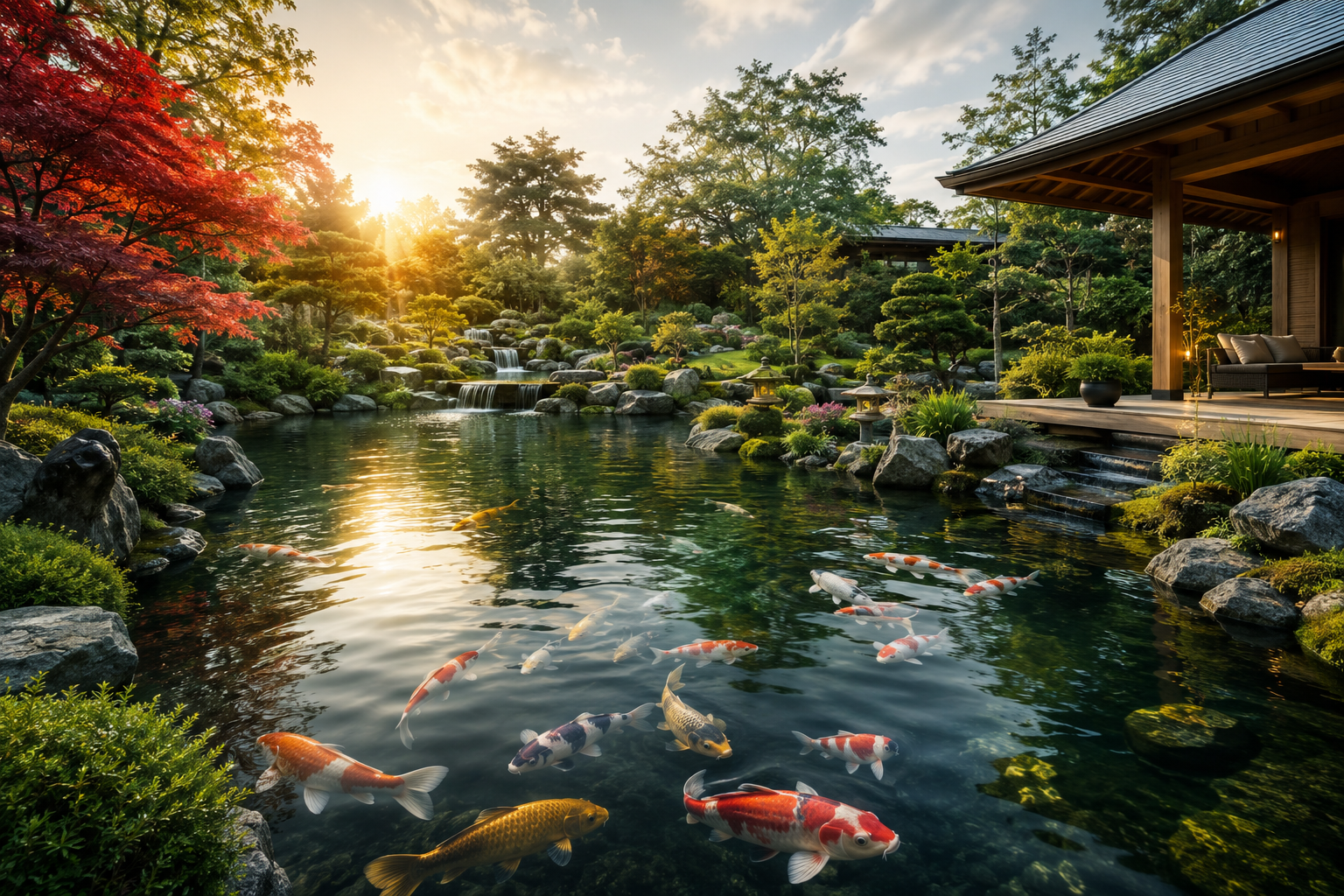
People often ask me what my ideal koi pond would look like.
Hugo’s Dream Pond is not simply a collection of products. It is the result of more than forty years of experience with koi keeping, pond construction, water gardening, publishing, filtration systems, water quality management, Korean koi breeding, and aquatic ecosystems.
Everything on this page contributes to Hugo’s Dream Pond: a pond designed around stable water quality, efficient filtration, strong biological balance, proper aeration, healthy koi, and long-term sustainability.
Over the years I have visited koi breeders, filtration manufacturers, water technology companies, researchers, and aquatic specialists throughout Europe and South Korea. Those experiences helped shape my vision of what a modern koi pond should be.
The Philosophy Behind Hugo’s Dream Pond
For me, a dream pond is not defined by expensive equipment alone. The best koi ponds combine water quality, filtration, oxygenation, observation, responsible stocking levels, practical maintenance, and continuous learning.
Products are important, but understanding the system is more important. Water comes first. The fish come second. Technology should support understanding, not replace it.
That is the foundation of Hugo’s Dream Pond.
Building Hugo’s Dream Pond
The technologies, companies, products, and ideas presented on this page are all connected to Hugo’s Dream Pond. Some are directly related to koi keeping, while others come from water treatment, environmental engineering, membrane technology, aquaculture, biological filtration, and aquatic design.
My experiences range from working with Korean koi breeder Kim Young Soo of Goyang Koi Farm to visiting manufacturers such as Evolution Aqua and researching alternative approaches including Plocher and PENAC.
Since I met Mickey Paulssen from Miroshaki, I have also followed the work of Takashi Amano, studied developments in aquascaping, explored Korean water technology, and documented many of these experiences through KoiTalk, Mantifang, and related publishing projects.
Water First
If I built a koi pond again, I would begin with water quality, not with the fish.
A pond should make testing, observing, cleaning, and correcting easy. That means good access, enough water volume, strong biological support, reliable oxygen, and clear routines.
The pond should not force the keeper to guess. It should help the keeper understand what is happening.
Water Testing and Monitoring
Hanna Instruments
For serious water testing and monitoring, Hanna Instruments is one of the companies I would watch closely for Hugo’s Dream Pond.
Traditional hobby test kits are useful, but digital pH meters, dissolved oxygen meters, alkalinity testing equipment, and professional water-quality tools can bring a pond keeper closer to the actual condition of the system.
That fits the way I think about koi keeping: observe first, measure when possible, and only then decide.
The Korean Influence
My interest in Korean water technology did not begin with a catalogue or a product list. It began in Korea.
Since 2003 I have worked closely with Korean koi breeder Kim Young Soo of Goyang Koi Farm. During my visits, one of the things that impressed me was that the fish house used Korean products and Korean technical solutions wherever possible.
I still remember the pleasure of helping to put together food from those products and feeding the koi myself every day. That kind of hands-on experience stays with you. It teaches you that serious koi keeping is not only about brands, but about systems, routines, trust, and the daily relationship between fish, water, food, and keeper.
Most koi hobbyists naturally look toward Japan, and rightly so. Nishikigoi belong to Japanese history. But Korea has its own knowledge, its own technology, and its own practical way of working with water.
That Korean experience is one of the reasons Hugo’s Dream Pond includes Korean water technology.
Coway
Coway is internationally known for water purification and consumer water systems. It is not a traditional koi company, but its work in filtration and water quality makes it interesting from a pond technology perspective.
LG Water Solutions
LG Water Solutions develops membrane technologies used in the global water treatment industry. These technologies operate far beyond the ordinary koi pond, but they point toward the future of filtration and water management.
Kolon Industries
Kolon has been involved in advanced materials and membrane technologies for environmental and water treatment systems.
For my dream pond thinking, these Korean companies are not included as standard hobby suppliers. They are included because they show where water technology may be heading.
Filtration and the Evolution Aqua Connection
Filtration is where biology, engineering, and pond design meet.
My interest in Evolution Aqua is not only technical. I visited Evolution Aqua and saw how ideas from the koi hobby developed into filtration systems that would later influence ponds across Europe.
There is also the Peter Waddington connection. Peter’s pond, famous among many serious koi people, ran on Evolution Aqua filtration. That made the company part of modern koi history for me, not just another manufacturer.
Evolution Aqua
Evolution Aqua helped popularize modern biological filtration systems for koi ponds. Products such as Nexus and EazyPod became familiar names in the hobby because they made serious filtration more understandable and accessible to many keepers.
OASE
OASE represents another important line in European pond technology. Over the years I have watched OASE grow from a respected pond company into one of the dominant names in water gardening and pond systems.
ProfiDrum
Modern drum filtration changed the way many advanced hobbyists think about mechanical filtration. For larger ponds and high-end systems, ProfiDrum represents the move toward cleaner, more automated, and more efficient waste removal.
Aeration and Oxygen
Oxygen is one of the most important elements in koi keeping, and it is often underestimated.
Fish need oxygen. Filter bacteria need oxygen. Warm water holds less oxygen. Heavy feeding increases biological demand. Hugo’s Dream Pond must take oxygen seriously from the beginning.
Hiblow
Hiblow air pumps have earned a strong reputation for reliability, efficiency, and long service life. They are the kind of practical technology that quietly supports a pond day after day.
Medo
Medo linear piston technology is respected for dependable air delivery and durability. It belongs naturally in any serious conversation about pond aeration.
Secoh
Secoh air pumps are widely known in pond aeration and aquaculture. Their long-standing reputation makes them worth considering in serious pond design.
Nutrition and Feeding
Food is never separate from water.
Every decision about feeding affects growth, body development, skin quality, waste production, filtration pressure, and water stability.
Hikari
Hikari remains one of the most widely recognized koi food manufacturers in the world. Its range includes feeds for growth, maintenance, seasonal feeding, and specialized needs.
Saki-Hikari
Saki-Hikari represents the premium side of the Hikari family and is known for probiotic formulations developed specifically for koi.
In Hugo’s Dream Pond, food choice should not be separated from water testing, filtration, oxygen, and stocking level.
Plocher, PENAC and Alternative Pond Thinking
Plocher and the PENAC system belong to a very personal chapter in my pond history.
In the 1990s, I introduced many Dutch pond and koi hobbyists to the work of Ronald Plocher and the PENAC system. I travelled to Meersburg in Germany, met Ronald Plocher personally, visited his production environment, and published an extensive Dutch-language article about his ideas, water treatment concepts, and energy system.
PENAC was never a conventional pond product in the same sense as a pump, filter, UV unit, or test kit. It belonged to a more unconventional field of thought around water, natural recovery, biological activation, energetic information, and the possibility that living systems respond to more than chemical measurements alone.
Whether one sees PENAC as pioneering, controversial, innovative, or unconventional, it remains one of the most recognizable alternative approaches in modern European pond history.
One sentence from Ronald Plocher stayed with me: problems do not exist, only situations. For koi keeping, that remains useful. A pond problem is usually a pond situation that has not yet been understood.
The Amano Connection
Like many people interested in aquatic systems, I followed the work of Takashi Amano with great interest. What fascinated me was not simply the beauty of the aquariums, but the underlying idea that water, plants, microorganisms, animals, light, and substrate together form a living system.
Some of the discussions surrounding PENAC also appeared within the early Nature Aquarium movement associated with Amano. Whether one agreed with every theory was almost beside the point. The real value was that they encouraged people to look more carefully at the invisible processes taking place beneath the surface.
The connection is also a personal one. Through Mickey Paulssen, the name Miroshaki became known within the aquascaping world through Fissidens sp. ‘Miroshaki’, creating an unexpected bridge between koi ponds, planted aquariums, aquascaping, and the broader search for natural balance in aquatic systems.
Future Technologies for Hugo’s Dream Pond
If I imagine a dream pond today, I also imagine technology that did not exist when I first entered the hobby.
Future ponds may combine water quality monitoring, oxygen management, remote alerts, automated feeding, environmental sensors, camera observation, and AI-assisted interpretation.
This does not mean replacing the keeper. It means giving the keeper better information.
A pond should still be observed with the eyes. But modern technology may help us notice changes sooner and understand them more clearly.
Companies, Products and Ideas I Am Watching
The Philosophy Behind My Dream Pond
The purpose of Hugo’s Dream Pond is not to own the most equipment.
The purpose is to create a stable environment where koi can thrive, water remains healthy, maintenance is manageable, and observation becomes enjoyable rather than stressful.
Technology can support that goal, but it can never replace understanding.
The best pond keepers are not necessarily those with the most expensive systems. They are the ones who understand their water, understand their fish, and continue learning year after year.
That remains my real dream pond.
About This Page
Hugo’s Dream Pond is an evolving resource within KoiTalk.
Future updates may include product reviews, direct manufacturer relationships, dealer recommendations, factory visits, interviews, Korean technology developments, Plocher and PENAC archive material, Amano-related notes, Miroshaki links, aquascaping history, and practical experiences from the koi hobby and water industry.
The goal is simple: to identify technologies, companies, products, people, and ideas that genuinely contribute to better koi keeping, healthier ponds, and deeper understanding.
Contact About Hugo’s Dream Pond
Do you have a question about Hugo’s Dream Pond, koi pond design, filtration, water quality, aeration, Korean water technology, Plocher/PENAC, Evolution Aqua, OASE, ProfiDrum, or one of the companies and ideas mentioned on this page?
You can use the form below for questions, suggestions, manufacturer contacts, dealer opportunities, product information, or relevant historical material.
Please include enough context so I can understand what you are referring to.