Mantifang archive connection
KoiTalk gives practical koi guidance. For the wider cultural archive behind water, Korea, ceramics, gardens and Mantifang’s older koi material, visit Mantifang.
Ultimate Koi Pond Filter Basics Guide
This koi pond filter basics guide explains how a koi pond filter removes solids, supports beneficial bacteria, protects oxygen, stabilizes water quality, and helps koi live well for years.
Why Koi Pond Filter Basics Matter
A koi pond is not safe simply because the water looks clear. Koi produce waste constantly. A good filter removes solids, supports pond bacteria, moves water, and helps prevent ammonia and nitrite problems before they become health risks.
Waste Control
Koi create solid and dissolved waste. Mechanical filtration removes visible solids before they break down and increase the pond’s biological load.
Biological Stability
Beneficial bacteria inside the filter help process ammonia and nitrite through the nitrogen cycle.
Fish Welfare
Stable filtration supports clear water, oxygen, better koi health, good growth, and lower stress.
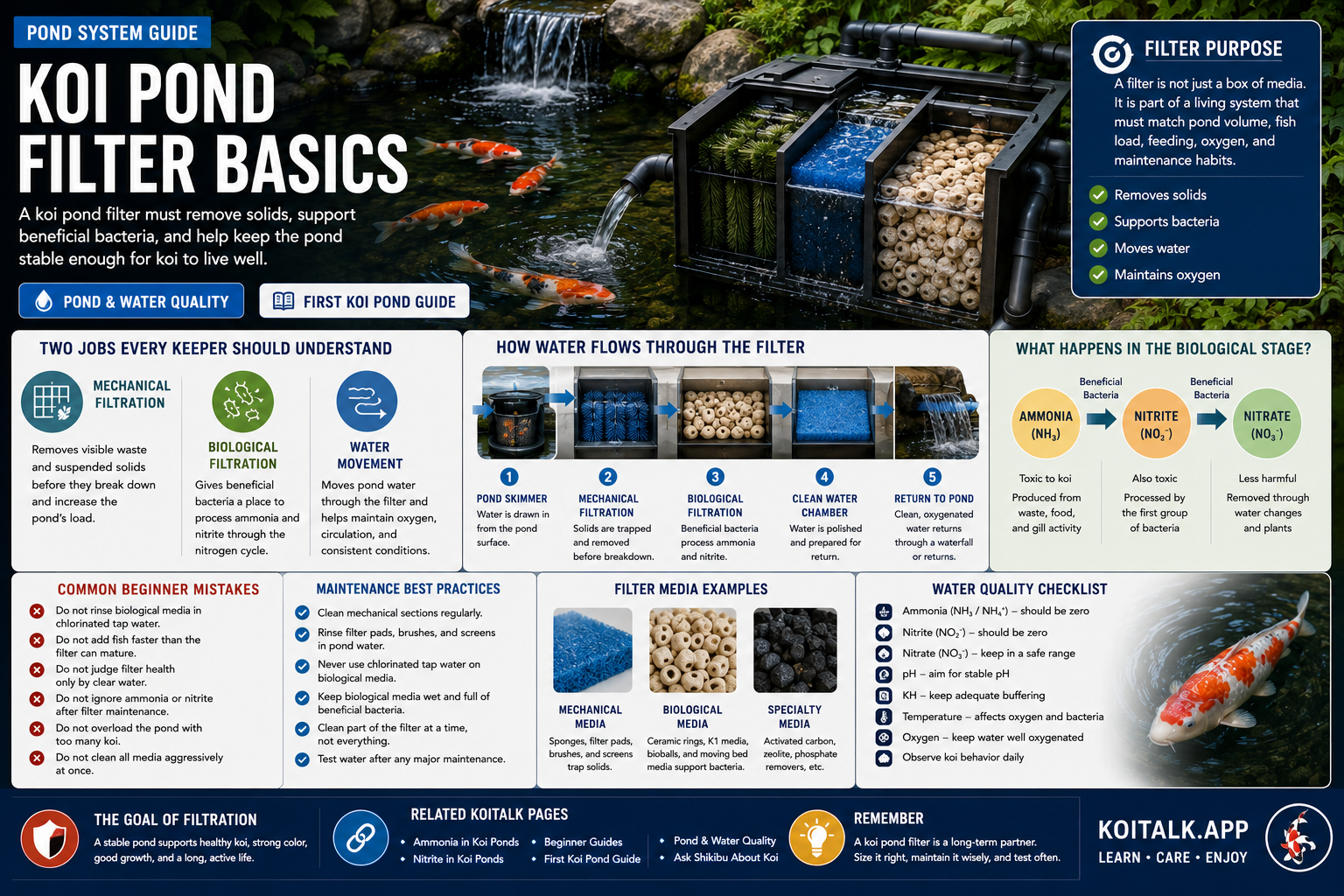
Two Jobs Every Koi Pond Filter Must Do
Every serious koi pond filtration system needs both mechanical filtration and biological filtration. Confusing these two jobs often leads to cloudy water, unstable chemistry, ammonia, nitrite, oxygen stress, and unhealthy fish.
Mechanical Filtration
Mechanical filtration removes visible waste, leaves, uneaten food, sludge, algae clumps, and suspended solids before they decay.
Biological Filtration
Biological filtration gives beneficial bacteria a place to process ammonia and nitrite through the koi pond nitrogen cycle.
Water Movement
Water movement carries pond water through the filter and helps maintain oxygen, circulation, and consistent pond conditions.
Koi Pond Filter Basics for Beginners
This guide keeps the first judgement practical. The best koi pond filter is not the biggest box or the most expensive unit. It is the system that matches the real pond, the real koi load, the feeding level, and the keeper’s maintenance routine.
- Remove Solids FirstUse mechanical filtration to catch waste before it breaks down in the pond.
- Protect Biological MediaBiological media houses the bacteria that process ammonia and nitrite.
- Keep Oxygen StrongKoi and filter bacteria both need oxygen, especially during warm weather and heavy feeding.
- Test the WaterClear water does not prove the filter is working. Test ammonia, nitrite, nitrate, pH, KH, and temperature.
- Match the Fish LoadA koi filter setup must match pond volume, koi size, stocking, feeding, and cleaning access.
Mechanical Filtration Explained
Mechanical filtration is the first practical layer of a koi pond filter system. Its job is to trap or separate solids so they do not rot in the pond and create extra ammonia pressure.
What It Removes
Mechanical filtration catches fish waste, leaves, food particles, algae clumps, and general pond debris.
Why Cleaning Matters
Captured waste still pollutes the pond if it is left to decay. Mechanical stages must be cleaned regularly.
Common Examples
Brushes, settlement chambers, sieves, screens, filter mats, vortex chambers, and drum filters are mechanical tools.
Biological Filtration Explained
Biological filtration is the living part of the system. Beneficial bacteria colonize filter media and help convert ammonia into nitrite and then nitrite into nitrate. This is the heart of koi pond filter basics.
Ammonia Processing
Ammonia comes from koi waste, gill activity, uneaten food, and decaying material. A mature biofilter helps process it.
Nitrite Processing
Nitrite can appear when the filter is immature, disrupted, or overloaded. The second bacterial stage must catch up.
Media Surface Area
Biological media gives bacteria surface area. Surface area matters only when flow, oxygen, and maintenance are also right.
Best Koi Pond Filter Setup for Beginners
A strong beginner setup separates waste removal from biological processing. The pond should move solids toward a mechanical stage first, then send cleaner water through biological media, and finally return oxygenated water to the pond.
Step 1: Solids Removal
Use a skimmer, bottom drain, sieve, settlement area, brushes, or other mechanical stage to reduce waste before it decays.
Step 2: Biological Media
After solids are reduced, water should pass through media where bacteria can process dissolved waste.
Step 3: Clean Return
Water should return with good movement and oxygen, helping the pond avoid dead zones and stagnant areas.
Gravity Filters vs Pressurized Filters
Both filter types can appear in koi ponds, but they behave differently. Beginners should understand access, cleaning, flow, oxygen, solids handling, and long-term maintenance before choosing.
Practical Comparison
- Gravity filters: often easier to inspect, clean, expand, and combine with bottom drains.
- Pressurized filters: compact and common in garden ponds, but may be easier to overload with serious koi stocking.
- Best choice: depends on pond size, fish load, budget, space, flow design, and maintenance habits.
- Warning: do not judge a system only by advertised pond volume. Koi load matters more than marketing numbers.
Moving Bed Filters, Static Media, and Drum Filters
Many koi ponds combine different filtration stages. Each stage has a job. A good koi pond filter system uses the right tool in the right place instead of expecting one chamber to do everything.
Moving Bed Filters
Moving bed filters use floating media with strong aeration. They are mainly biological and need good pre-filtration before them.
Static Media
Static media can trap finer solids or provide bacterial surface, depending on design. It must be cleaned without destroying the biological balance.
Drum Filters
Drum filters remove fine solids automatically. They can be powerful mechanical stages, but still need biological filtration after them.
Flow, Oxygen, and Pond Circulation
A filter cannot work well without water movement and oxygen. Flow brings waste to the filter. Oxygen supports koi, bacteria, and the whole pond system.
- Water should move through the filter at a useful and consistent rate.
- Dead zones in the pond allow waste to settle and decay.
- Air pumps, waterfalls, returns, and moving water support oxygen.
- Warm water holds less oxygen and increases demand.
- Heavy feeding increases waste and oxygen pressure.
- Low oxygen can reduce biological filter performance.
- Pumps, pipes, valves, and returns should be easy to inspect.
Filter Media and Maintenance
Filter media is not magic. It works only when water, oxygen, cleaning habits, and pond load are balanced. Good maintenance protects the bacteria while removing waste.
Mechanical Media
Mechanical media catches solids and should be cleaned before trapped waste rots inside the filter.
Biological Media
Biological media should not be cleaned aggressively. Its bacteria are part of the pond’s stability.
Safe Cleaning
Do not rinse biological media in chlorinated tap water. Use pond water when cleaning sensitive biological sections.
How Often Should You Clean a Koi Pond Filter?
There is no single cleaning schedule for every pond. Cleaning depends on fish load, feeding, season, solids collection, filter type, algae, leaves, and how quickly waste builds up.
- Clean mechanical stages before trapped waste starts to decay.
- Inspect filters more often during warm weather and heavy feeding.
- Clean less aggressively in biological sections.
- After major cleaning, test ammonia and nitrite.
- Do not clean all biological media at once unless there is a clear reason.
- Keep filter access practical so cleaning does not become neglected.
Common Beginner Mistakes
A filter can be too small, cleaned too aggressively, starved of oxygen, or expected to handle more koi than the pond should carry.
- Judging filter health only by clear water.
- Adding fish faster than the filter can mature.
- Rinsing biological media in chlorinated tap water.
- Cleaning all media too aggressively at once.
- Ignoring ammonia or nitrite after filter maintenance.
- Overfeeding while the filter is immature or unstable.
- Using decorative pond filtration for a heavy koi load.
- Choosing a filter with no practical cleaning access.
Why Clear Water Can Still Be Dangerous
Clear water is visually reassuring, but it does not prove safe chemistry. Ammonia, nitrite, poor KH, unstable pH, and low oxygen can exist in water that looks clean.
Invisible Ammonia
Ammonia can irritate gills and skin even when the pond looks clear.
Invisible Nitrite
Nitrite can interfere with oxygen transport and should be tested in new or unstable ponds.
Invisible Instability
pH and KH problems may not be visible until fish behavior or filter performance changes.
Testing After Filter Changes
Any filter cleaning, media replacement, pump failure, medication, power cut, or new fish addition can affect water quality. Testing is how you know whether the filter is coping.
Ammonia
Ammonia can rise when waste load increases or biological filtration is not mature enough.
Nitrite
Nitrite can rise when ammonia is being processed but the second bacterial stage is not yet stable.
Nitrate
Nitrate shows later nitrogen-cycle activity but still needs management through water care and stocking control.
pH and KH
KH helps buffer pH and supports biological filtration. Low stability can make pond management harder.
Temperature
Temperature affects feeding, fish metabolism, oxygen, and filter bacteria activity.
Fish Behavior
Watch for gasping, clamped fins, flashing, isolation, or reduced appetite after filter disruption.
Troubleshooting a Koi Pond Filter
When the pond becomes cloudy, smelly, unstable, or stressful for fish, treat the filter as part of a complete system. The cause may be waste load, flow, oxygen, cleaning habits, or stocking.
- Cloudy water: check mechanical filtration, suspended solids, algae, feeding, and filter maturity.
- Ammonia present: reduce feeding, check biological maturity, oxygen, and stocking load.
- Nitrite present: review cycling, filter disruption, recent cleaning, and new fish additions.
- Low oxygen signs: increase aeration and check warm weather, overstocking, algae, and flow.
- Dirty filter smell: remove trapped waste and improve cleaning routine.
- Repeated problems: consider whether the system is undersized for the koi load.
Koi Pond Filter Basics Q&A
What does a koi pond filter do?
A koi pond filter removes solids, supports beneficial bacteria, moves water, and helps protect water quality for koi health.
Is clear water proof that the filter works?
No. Clear water can still contain ammonia, nitrite, poor KH, or low oxygen. Testing is more reliable than appearance.
What is mechanical filtration?
Mechanical filtration removes visible solids such as fish waste, leaves, uneaten food, and suspended debris.
What is biological filtration?
Biological filtration gives bacteria a place to process ammonia and nitrite through the nitrogen cycle.
What is a koi pond biofilter?
A koi pond biofilter is the biological part of the system where bacteria process dissolved waste.
Can I clean all filter media at once?
Be careful. Cleaning everything aggressively can reduce beneficial bacteria and destabilize the pond.
Why should I not rinse biological media in tap water?
Chlorinated tap water can harm beneficial bacteria. Use pond water for sensitive biological media.
How do I know if my filter is too small?
Warning signs include repeated ammonia or nitrite, poor solids removal, cloudy water, heavy maintenance pressure, or stressed fish.
Should filter size match pond volume only?
No. It should also match koi size, stocking level, feeding, oxygen, maintenance routine, and waste load.
Do koi need more filtration than goldfish?
Usually yes. Koi grow larger, eat more, produce more waste, and need stronger long-term filtration.
What is the best koi pond filter?
The best koi pond filter is the one that matches fish load, pond volume, feeding, flow, oxygen, and cleaning access.
How often should I test after filter cleaning?
Test ammonia and nitrite after major filter work, new fish additions, medication, pump failure, or sudden water-quality changes.
Does a drum filter replace biological filtration?
No. A drum filter removes solids. The pond still needs biological filtration to process ammonia and nitrite.
Why is oxygen important for filtration?
Koi and beneficial bacteria both need oxygen. Low oxygen can stress fish and reduce biological filter performance.
Can overfeeding overload a filter?
Yes. More food creates more waste, which increases pressure on mechanical and biological filtration.
Further Reading
Filter basics should be read alongside water testing, stocking decisions, and beginner pond planning.
Next Step
Use this koi pond filter basics guide as the starting point for stable water. Then test ammonia and nitrite, review fish load, protect oxygen, and match the filter to the pond you actually keep.