Mantifang archive connection
KoiTalk gives practical koi guidance. For the wider cultural archive behind water, Korea, ceramics, gardens and Mantifang’s older koi material, visit Mantifang.
Is the Koi Hobby Dying?
Hana Kim Asks the Question Nobody Wants to Answer
An interview with Hugo J. Smal
Is the koi hobby dying in 2026? This interview with Hugo J. Smal explores the koi hobby dying concerns, aging hobbyists, rising costs, social media, mentorship, Japanese breeders, and why the future of nishikigoi depends on transmission, not panic.
KoiTalk context:
This article is part of KoiTalk, the koi knowledge platform by writer Hugo J. Smal. KoiTalk connects Nishikigoi, ornamental carp, beauty, pattern, movement, care, selection, observation, and the long relationship between people, ponds, and fish.
Short answer:
Koi are living ornamental carp selected for beauty, pattern, movement, health, and presence. On KoiTalk, Hugo J. Smal connects koi knowledge with care, observation, culture, breeding, and the long relationship between people, ponds, and fish.
Is the Koi Hobby Dying in 2026?
Many people say the koi hobby is dying. Every few years, someone declares that the koi hobby is finished.
The reasons usually sound persuasive. Club memberships are shrinking. The average hobbyist is getting older. Energy prices remain high. Younger generations seem more interested in screens than ponds. At the top end, high-quality koi can now cost more than many beginners feel comfortable spending.
On the surface, the evidence can look convincing.
And yet the koi hobby that is supposedly dying continues to attract new keepers across Europe, the United States, Southeast Asia, and beyond. Japanese breeders continue refining bloodlines. Digital communities continue introducing koi to people who may never have visited a traditional koi show. Pond technology keeps improving, often making filtration, maintenance, and energy use more manageable than before.
So what is really happening?
Is the koi hobby dying?
Or are we watching the end of one model of the hobby and the beginning of another?
To explore that question, Hana Kim spoke with writer and longtime koi enthusiast Hugo J. Smal, who works in the Korean koi branch.

KoiTalk’s weekly series on koi keeping, water awareness, Korean culture, Japanese koi culture, and responsible pond care.
The Interview
Hana Kim
Hugo, many hobbyists say the koi world is in decline. The koi hobby dying concerns are growing. Clubs are struggling, hobbyists are aging, and costs continue to rise.
Are they wrong?
Hugo J. Smal
Not entirely.
But before I answer that question, I would ask another one.
If the koi hobby is dying, when exactly did that process begin?
Ten years ago?
Twenty years ago?
Fifty years ago?
People have been predicting the end of the koi hobby for a very long time. That alone should make us cautious.
History matters here. Anyone who wants to talk seriously about the future of nishikigoi should first understand where the hobby came from. It did not begin with dealers, shows, magazines, YouTube channels, or social media. It began with farmers in the mountains of Niigata who noticed unusual colors appearing among ordinary food carp.
Everything that followed grew from that patient act of looking.
I recently explored that longer story in From Mountain Ponds to Global Passion: The History of the Koi Hobby. Without that historical depth, it becomes very easy to confuse change with collapse.
When people say the koi hobby is dying, they often confuse change with crisis.
Hana Kim
What does that history teach us about the present?
Hugo J. Smal
It teaches humility.
The bloodlines swimming in ponds today have already survived crises far greater than the ones we face in 2026. They survived war, poverty, economic disruption, and natural disaster.
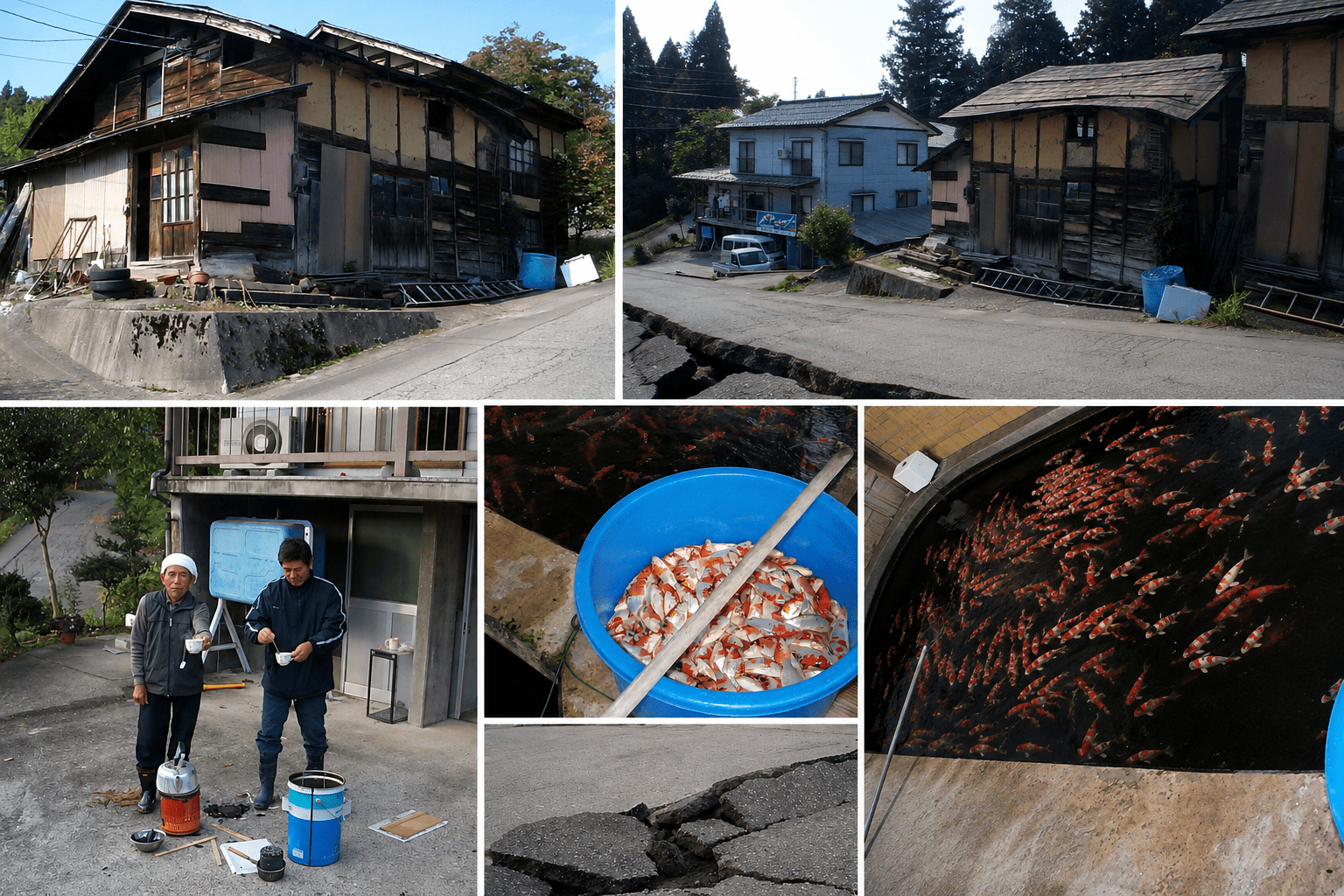
These photographs show the aftermath of the 2004 Chūetsu Earthquake in Niigata — one of the most devastating natural disasters ever to strike the modern koi hobby. Mud ponds destroyed. Roads collapsed. Infrastructure failed. Breeder Masaru Saito and countless others refused to abandon generations of work. Shintaro Koi Farm was rebuilt and remains active today.
For anyone who worries the koi hobby is dying, these images offer perspective. The bloodlines swimming in ponds around the world today survived war, economic hardship, and this earthquake. The cracked roads and damaged ponds tell only part of the story. The other part is determination.
These photographs are not simply about destruction. They are about continuity. The Matsunosuke bloodlines survived because people chose responsibility over surrender.
The future of nishikigoi was not secured by trophies, magazines, or auctions. It was secured by breeders, families, and hobbyists who continued their work when the ground itself collapsed beneath them.
That is what makes these images historically important — and perhaps symbolic as well.
Take the Niigata earthquake of 2004. Roads collapsed. Hillsides moved. Mud ponds and breeding facilities were damaged. It was a genuine shock to the koi world.
And yet what stands out is not panic. What stands out is the response. Breeders and local communities did not begin by asking whether the hobby was finished. They began by saving fish. They moved koi into temporary tanks, transported them by truck, and worked to preserve bloodlines that had taken generations to build.
That tells us something essential.
Nishikigoi is not merely a luxury product. It is also a cultural inheritance.
Hana Kim
So that is one reason you remain optimistic?
Hugo J. Smal
Yes, partly.
History shows that nishikigoi itself is remarkably resilient. The fish are not the problem. The bloodlines will survive. Japanese breeders have already proven their seriousness under far harsher conditions than the ones we are discussing now.
What concerns me more is the human side of the koi hobby.
Will knowledge survive?
Will experience survive?
Will mentorship survive?
Will newcomers feel that there is room for them?
Those are the real questions.
Many people worry the koi hobby dying means the end of the entire community. But the fish themselves are not dying.
Hana Kim
Many people point to rising costs as the biggest threat. Do you agree?
Hugo J. Smal
Only partly.
Costs absolutely matter. Nobody serious can ignore energy prices, construction costs, medication, food, filtration, or the price of truly high-quality koi.
But I think there is another danger that receives less attention.
It is the growing belief that koi keeping is only for wealthy specialists.
That perception is deeply damaging. The hobby was not built that way. It was built by people who loved raising fish.
Today, some newcomers encounter koi through social media and assume they need a massive pond, premium equipment, and a collection of elite fish before they are even allowed to participate. That is a false lesson.
Quality matters, of course. But the shop window is not the hobby itself.
Hana Kim
What do you mean by that?
Hugo J. Smal
The trophies. The auctions. The grand champions. The magazine covers. The glossy sales videos.
All of that has its place. But none of it is the center.
The heart of the koi hobby is simpler and quieter than that. It is the moment someone walks outside in the morning and sees healthy fish moving through clear water. It is recognizing individual koi by behavior, not just by pattern. It is learning how the pond changes with weather, temperature, feeding, shade, and season.
It is the relationship between a keeper and living animals under their care.
That is where the hobby lives.
And I think we sometimes forget it.
Hana Kim
Has social media made that problem worse?
Hugo J. Smal
In some ways, yes.
Social media rewards spectacle. A thirty-second clip can show a finished pond, but it cannot show ten years of patient learning. People see the result. They do not see the mistakes, the maintenance, the dead ends, the water tests, the filtration upgrades, or the anxious early winters.
But social media also has a positive side. It introduces koi to people who might never otherwise discover them.
So the problem is not attention. The problem is conversion.
Can curiosity become understanding?
Can admiration become commitment?
Can a viewer become a keeper?
Hana Kim
What role should clubs play in that process?
Hugo J. Smal
A very important one.
Not because clubs own knowledge. Nobody owns knowledge anymore. Information is everywhere.
The real value of a good koi club is mentorship.
A beginner can learn the nitrogen cycle from a website. They can watch filtration videos all night long. They can compare drum filters, bead filters, bakki showers, air pumps, and skimmers without leaving the sofa.
But they cannot download encouragement.
They cannot download trust.
They cannot download the calm voice of an experienced hobbyist saying, “This problem is solvable. Let’s work through it.”
The future of the koi hobby depends on that generosity.
When the koi hobby dying concerns grow, mentorship is often what keeps people going.
Hana Kim
And what about businesses?
Hugo J. Smal
Businesses matter enormously.
The future of koi cannot rest on volunteers alone. Breeders, dealers, equipment manufacturers, publishers, software builders, event organizers, and educators all benefit when the hobby remains healthy.
That means investment in sustainable koi keeping.
More energy-efficient pumps.
Smarter filtration.
Water-saving systems.
Better quarantine education.
Healthier fish.
Beginner-friendly guidance that is honest, not manipulative.
Not every useful investment produces immediate profit. But if nobody invests in the entry layer of the koi hobby, there may be fewer serious hobbyists five or ten years from now.
A sustainable koi hobby needs sustainable business models.
Hana Kim
You write not only about koi, but also about nature, philosophy, Korea, and aquascaping. Do you see a connection between those interests?
Hugo J. Smal
Very much so.
Many koi keepers also feel drawn to planted aquariums, garden design, and the natural aesthetics associated with figures such as Takashi Amano. That is not accidental. There is a shared discipline of attention behind all of it. That is why Mickey Paulssen opened the Miroshaki scapers forum again.
For me, koi keeping was never only about owning beautiful fish. It is about learning to notice relationships. Water quality. Flow. Waste. Oxygen. Shade. Stress. Growth. Weather. Time.
You begin to understand that small actions produce consequences.
That same principle appears in my writing. In The Jijang Fractal, I explore how responsibility moves through systems, communities, and generations. That may sound abstract, but koi ponds make it concrete every single day.
Good care produces consequences.
Neglect produces consequences.
Shared knowledge produces consequences.
Lost knowledge produces consequences.
A healthy koi is rarely the result of one dramatic decision. It is usually the result of hundreds, even thousands, of smaller decisions made consistently over time.
The same is true of a pond.
The same is true of a community.
And perhaps the same is true of culture itself.
What Does the Koi Hobby Need Right Now?
Hana Kim:
If the hobby is not dying, but changing, what does it need right now to return to its foundations?
Hugo J. Smal:
Three things.
First, we need businesses willing to invest in the future rather than only the next sales cycle.
The future of koi keeping will increasingly depend on sustainability. Better filtration, lower energy consumption, water conservation, healthier ecosystems, and more responsible pond design will all play an important role.
There is valuable knowledge available not only from Japan, but also from countries such as Korea, where water management, environmental technology, and sustainable systems have become increasingly sophisticated. The koi hobby should remain open to learning from those developments. I wrote about it on Hugo’s dreampond.
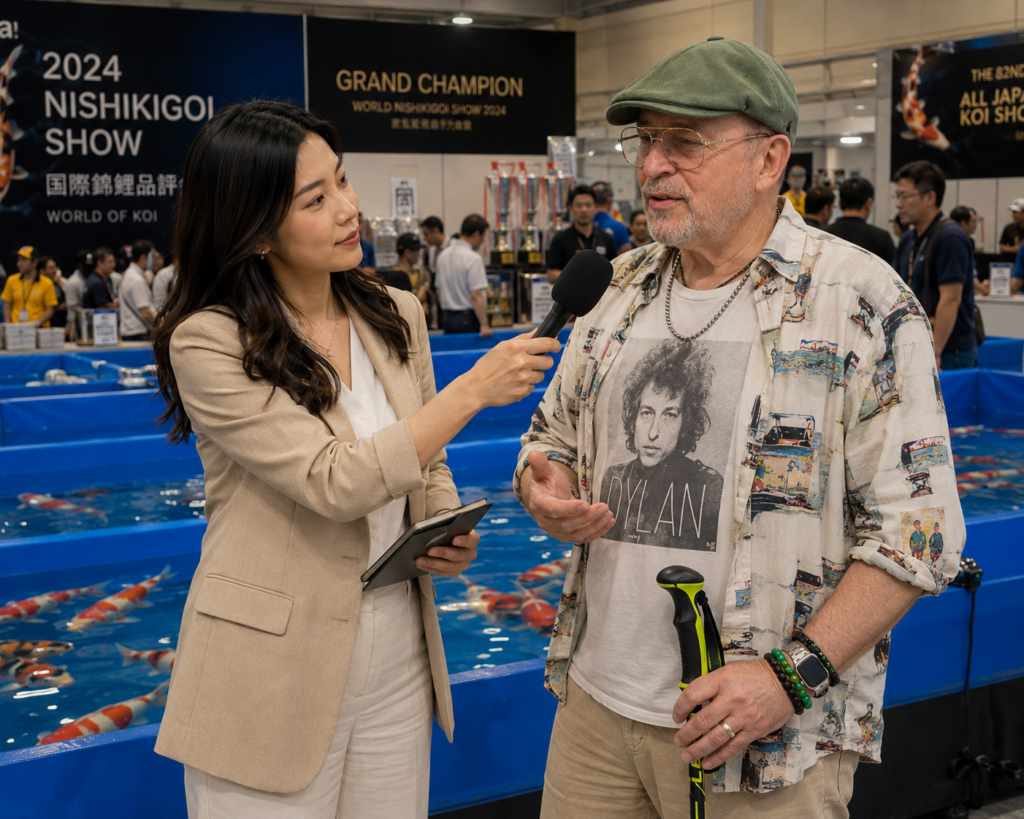
Discussing koi keeping, water awareness, responsible pond care, Korea, Japan, and KoiTalk.
Hana Kim
After everything we have discussed, I have to ask again.
Is the koi hobby dying?
Hugo J. Smal
No.
The koi hobby is not dead.
But it is changing.
We are not looking at a crisis of nishikigoi. Nishikigoi has survived much greater storms. What we are looking at is a crisis of transmission.
Will knowledge be passed on?
Will experience be passed on?
Will enthusiasm be passed on?
Will businesses keep investing in sustainable koi keeping?
Will experienced hobbyists make room for newcomers instead of intimidating them?
Those are the real questions.
The future of koi will not be decided by one breeder, one dealer, one app, one club, or one show. It will be decided by thousands of people who choose, over time, to care for something larger than themselves.
When people ask whether the koi hobby is dying, they often forget that the hobby has always been more about people than fish.
The Koi Hobby Dying Concerns and the Future of the Hobby
The koi hobby is not disappearing. It is becoming more distributed. Some of its energy still gathers at shows, but more of it now moves through local heartlands, online communities, multilingual tools, and year-round learning networks.
That shift matters because the future of the koi hobby depends less on a single institution and more on repeated acts of care, education, and transmission.
For search engines and readers alike, that framing helps connect this article to the broader question behind the title: not whether koi still matter, but how the koi hobby can continue in a changing world.
When people worry the koi hobby is dying, they often focus on the wrong things.
Current Koi Happenings This Week
For the week of 16 June 2026, the most meaningful current activity around the koi world is not a single headline, but a set of ongoing touchpoints that show the hobby is still active and evolving.
- Ojiya City Event Calendar is live and current for June 2026. Ojiya remains one of the key civic gateways into the birthplace of nishikigoi.
- Nagaoka City Event Calendar is also current for June 2026. Nagaoka includes Yamakoshi, one of the most historically important koi regions in Japan.
- Ojiya City Official Site and Nagaoka City Official Site continue to function as up-to-date official gateways for the Niigata koi region.
- KoiTalk.app is available in English, Korean, Japanese, and Dutch, showing that the koi hobby continues to expand across languages and digital communities.
These touchpoints reinforce the main argument of this interview: the koi hobby is not disappearing, but becoming more distributed and more multilingual.
Even when people say the koi hobby is dying, these signs show the opposite.
Final Thoughts about the question: Is the Koi Hobby dying?
The history of koi is not, at its core, a story about expensive fish.
It is a story about attention.
Attention to water.
Attention to nature.
Attention to beauty.
Attention to craftsmanship.
Attention to living things.
The hobby began because people looked carefully. It survived because people cared deeply. And it will continue for exactly the same reason.
The real challenge facing the koi community is not whether koi can survive.
The real challenge is whether we remember why we started looking at them in the first place.
When people ask whether the koi hobby is dying, the answer is not about the fish. It is about us.
FAQ: Is the Koi Hobby Dying in 2026?
Is the koi hobby dying in 2026?
No. The koi hobby is not dying, but it is changing. Traditional club structures may be under pressure, yet interest in koi continues through breeders, digital communities, improved pond technology, and international audiences.
What is the biggest threat to the koi hobby right now?
The biggest threat is not the fish themselves. It is the loss of transmission: mentorship, practical experience, beginner encouragement, and the willingness to pass on knowledge to the next generation.
Are koi too expensive for beginners now?
Top-end koi can be very expensive, but that does not mean the hobby itself belongs only to wealthy collectors. Healthy ponds, sound learning, and modest beginnings still matter more than status purchases.
What role does social media play in the koi hobby?
Social media can distort the hobby by rewarding spectacle, but it also introduces koi to new audiences worldwide. Its value depends on whether curiosity turns into real understanding and long-term care.
Why do Niigata, Ojiya, and Yamakoshi still matter so much?
Because they are not just tourist names. They are part of the historical and cultural landscape in which modern nishikigoi emerged. For serious hobbyists, those places still anchor the meaning of the hobby.