Mantifang archive connection
KoiTalk gives practical koi guidance. For the wider cultural archive behind water, Korea, ceramics, gardens and Mantifang’s older koi material, visit Mantifang.
Water quality guide
Ammonia in Koi Ponds
Ammonia in koi ponds is one of the first serious water-quality risks every koi keeper must understand. It can rise in new ponds, overstocked ponds, overfed ponds, poorly filtered ponds, or systems where the biological filter has been disturbed.
Why Ammonia in Koi Ponds Matters
Ammonia in koi ponds comes from fish waste, gill activity, uneaten food, decaying leaves, dead algae, sludge, and immature filtration. A mature biological filter converts ammonia as part of the pond nitrogen cycle.
Ammonia Starts With Waste
Every koi pond produces waste. The issue is whether the pond can process ammonia safely through biological filtration, oxygen, stable KH, sensible feeding, and a fish load that matches the system.
New Ponds Are Vulnerable
A new pond or new filter may not yet have enough nitrifying bacteria. This is often called new pond syndrome, and ammonia in koi ponds often appears before the filter is fully mature.
Context Changes Risk
Ammonia readings should be interpreted together with pH and temperature. The same ammonia result can become more dangerous in warmer water and at higher pH.
Common Causes of Ammonia in Koi Ponds
Most ammonia problems have a practical cause. Before adding treatments, look at the pond as a whole system: fish load, feeding, filtration, oxygen, filter maturity, and recent changes.
- Too many koi for the pond volume or filter capacity.
- Overfeeding, especially in cool water or unstable weather.
- A new pond or filter that has not matured yet.
- Cleaning filter media too aggressively and removing useful bacteria.
- Dead leaves, plant material, sludge, dead algae, or uneaten food.
- A recent medication or chemical treatment that affected filter bacteria.
- Low oxygen, which reduces filter performance and increases fish stress.
Possible Signs of Ammonia Stress
Koi behavior is an early warning system, but behavior alone is not enough. Always test the water before deciding that ammonia in koi ponds is the only problem.
Breathing and Gills
Koi may gasp, breathe heavily, gather near water returns, or spend more time near the surface if ammonia, oxygen, pH, or nitrite is causing stress.
Body Language
Clamped fins, lethargy, flashing, jumping, isolation, or reduced appetite can all justify immediate water testing.
Secondary Health Problems
Ammonia stress can weaken koi and make other problems worse. Skin irritation, gill stress, parasites, ulcers, or bacterial issues may appear alongside poor water quality.
First Response to Ammonia in Koi Ponds
Do not make sudden, poorly understood changes. The first goal is to reduce risk while protecting oxygen and biological filtration.
- Stop or reduce feeding while the pond is unstable.
- Increase aeration, especially if koi are breathing heavily.
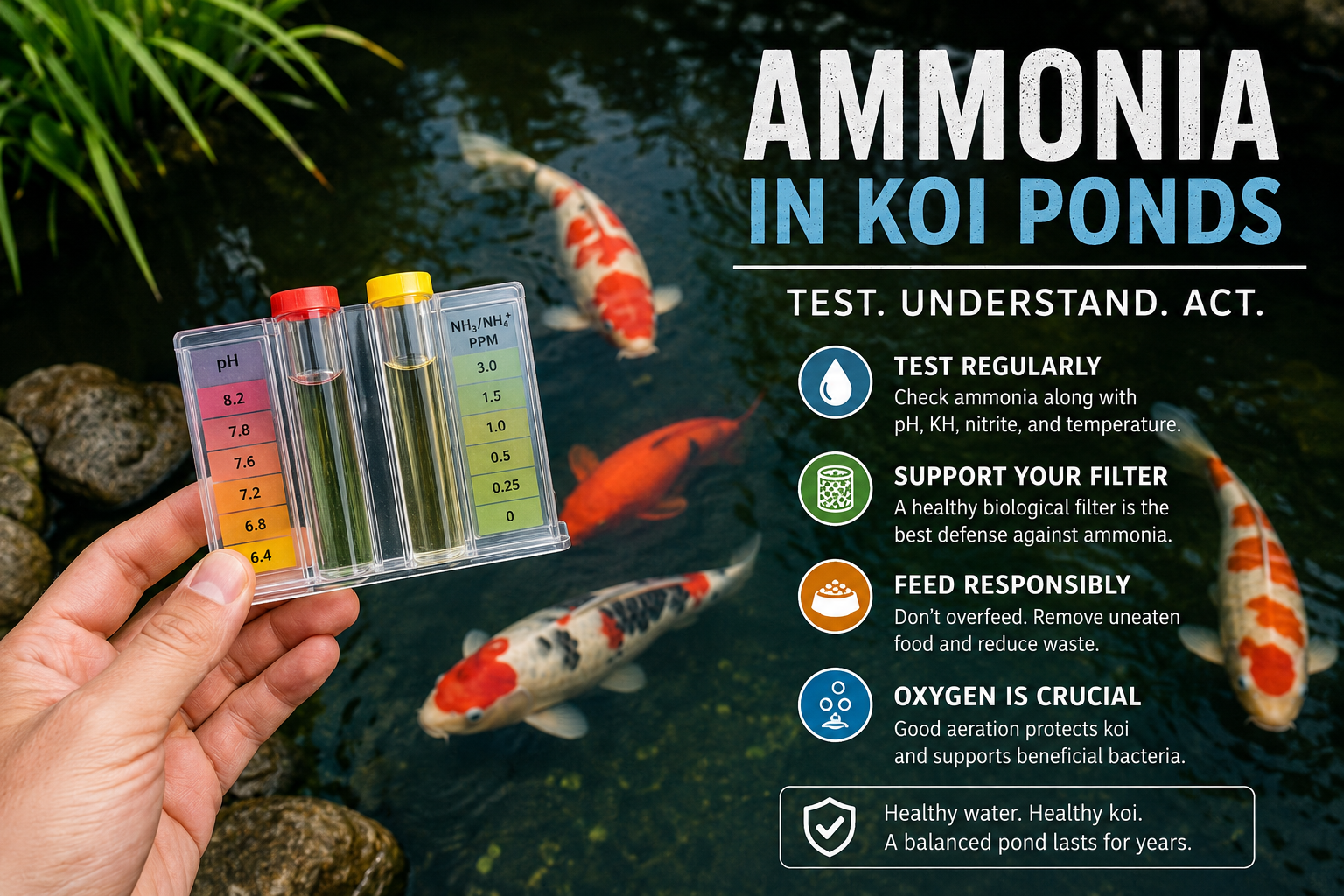
- Retest ammonia, pH, KH, nitrite, nitrate, and temperature.
- Check whether pumps, air pumps, bottom drains, skimmers, and filters are working correctly.
- Remove uneaten food, dead leaves, sludge, or decaying organic material where possible.
- Review recent filter cleaning, new fish, treatments, power cuts, or stocking changes.
- Avoid adding multiple products at once unless you understand their effect on the pond.
Testing Ammonia Properly
Ammonia should never be judged from one number alone. A useful test routine connects ammonia in koi ponds to pH, KH, temperature, oxygen, nitrite, nitrate, and filtration.
Test the Same Day
If koi look stressed, test immediately. Do not rely on old readings. Pond conditions can change quickly after feeding, storms, filter problems, power cuts, or warm weather.
Record the Pattern
Write down the ammonia result, time, temperature, pH, feeding level, and fish behavior. A pattern over several days is more useful than one isolated result.
Watch Nitrite Next
When a filter begins processing ammonia, nitrite may rise next. That is why ammonia in koi ponds and nitrite problems should be understood together.
Ammonia and the Biological Filter
The long-term solution is usually not a single emergency product. Stable water depends on enough biological filtration, oxygen, sensible feeding, and a fish load that matches the pond.
What to Check
- Is the filter large enough for the number and size of koi?
- Is water flowing through the biological media correctly?
- Was the filter recently cleaned with chlorinated tap water?
- Is there enough oxygen for both koi and filter bacteria?
- Has feeding increased faster than the filter can handle?
What Not to Do
Many ammonia problems become worse because the pond keeper reacts too quickly without understanding the cause.
Do Not Keep Feeding Normally
Food creates more waste. If ammonia in koi ponds is present, feeding should usually be reduced or paused while you test the pond and correct the cause.
Do Not Destroy Filter Bacteria
Aggressive filter cleaning can remove the bacteria needed to process ammonia. Clean mechanical waste carefully, but protect biological media.
Do Not Guess From Symptoms Alone
Gasping, flashing, and lethargy can have several causes. Test water first, then decide whether parasites, oxygen, pH, nitrite, or other issues may also be involved.
When to Ask for Help
If koi are gasping, collapsing, lying on the bottom, showing severe gill stress, developing sores, or if ammonia remains present despite corrective action, ask an experienced koi professional or qualified aquatic veterinarian for help. Serious koi health problems should not be handled by guesswork.
Q&A: Ammonia in Koi Ponds
What causes ammonia in koi ponds?
Ammonia in koi ponds usually comes from koi waste, uneaten food, decaying organic material, overstocking, immature filters, or damaged biological filtration.
Why is ammonia dangerous for koi?
Ammonia can irritate and damage the gills, increase stress, reduce appetite, and weaken koi. Risk depends strongly on pH, temperature, oxygen, and exposure time.
Should I stop feeding when ammonia is present?
In most cases, yes. Reducing or pausing feeding helps lower waste production while you test the pond and correct the cause.
Can a new pond have ammonia even if the water looks clean?
Yes. Clear water does not mean safe water. New ponds can have ammonia because the biological filter is not yet mature.
What should I test together with ammonia?
Test pH, KH, nitrite, nitrate, and temperature. Oxygen and filtration should also be checked when koi show stress.
Is ammonia always a filter problem?
Not always. Ammonia in koi ponds can also be caused by feeding, stocking, dead organic matter, medication, power cuts, or sudden seasonal changes.
Further Reading
Use these pages to understand the wider water-quality picture before treating symptoms in isolation.
Next Step
Do not look at ammonia alone. Test the full pond picture, reduce stress, protect oxygen, and check whether your filter can safely process the waste your koi produce.