
Mantifang archive connection
KoiTalk gives practical koi guidance. For the wider cultural archive behind water, Korea, ceramics, gardens and Mantifang’s older koi material, visit Mantifang.
Koi health guide
Koi Parasites Guide
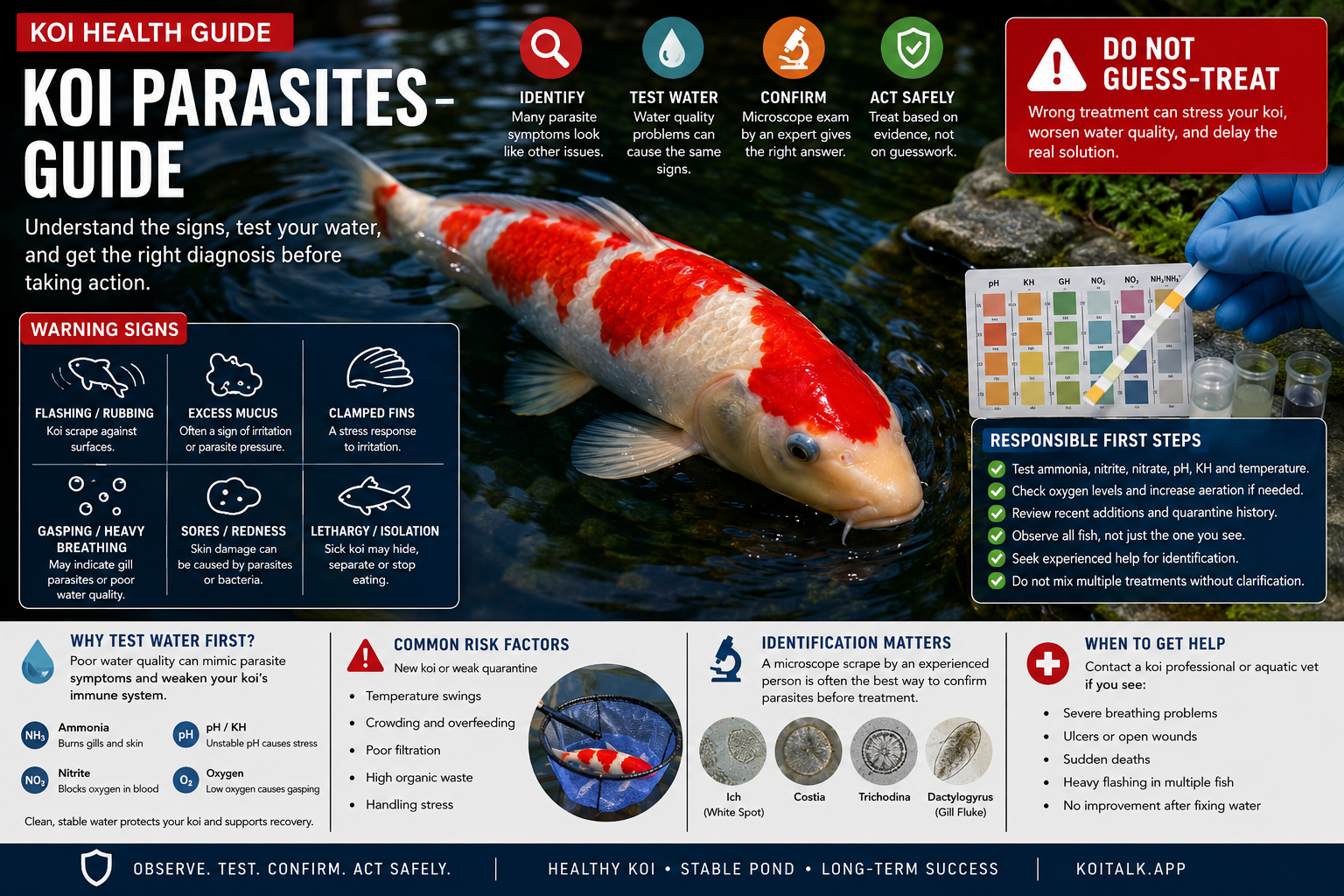
This koi parasites guide explains common warning signs, why water quality still matters, how parasite suspicion should be investigated, and when proper identification or professional help is needed.
Why Koi Parasites Need Careful Identification
Koi parasites can irritate skin, fins, and gills, but visible behavior alone rarely proves the exact cause. Flashing, rubbing, jumping, excess mucus, or breathing changes are reasons to investigate, not a final diagnosis.
Symptoms Overlap
Many parasite signs also appear with ammonia, nitrite, low oxygen, pH instability, stress, crowding, or bacterial infection.
Water Comes First
Before assuming parasites, test ammonia, nitrite, nitrate, pH, KH, temperature, and oxygen conditions.
Evidence Matters
A microscope scrape by someone experienced is often the safest way to confirm many koi parasite issues before choosing treatment.
Common Warning Signs of Koi Parasites
This koi parasites guide treats symptoms as clues. A single sign is rarely enough. Look for patterns across fish behavior, body condition, gill movement, recent pond changes, and water readings.
Behavior Changes
Flashing, rubbing, jumping, clamped fins, isolation, hanging near returns, or unusual surface behavior may justify closer review.
Body Signs
Excess mucus, redness, damaged fins, raised irritation, small wounds, sores, or visible discomfort can appear with parasite pressure or other stressors.
Breathing Problems
Heavy breathing, gasping, one-sided gill movement, or gathering near aeration may point to gill irritation, water quality problems, or oxygen stress.
Group Pattern
If several koi show similar signs, the pond system needs immediate review. Test water and consider whether a parasite problem, oxygen issue, or recent change is involved.
Recent Additions
New koi, weak quarantine, shared equipment, or recent transport can increase the risk of introducing parasites or triggering stress.
Seasonal Stress
Temperature swings, spring start-up, heavy feeding, spawning, and crowding can make koi more vulnerable and make symptoms more visible.
Responsible First Steps
The safest first response is not panic treatment. Start with measurement, observation, quarantine history, and experienced identification.
- Test ammonia, nitrite, nitrate, pH, KH, and temperature.
- Increase aeration if koi show breathing stress.
- Check whether one fish or many fish are affected.
- Review recent koi additions, quarantine history, transport, and treatments.
- Look for sores, damaged fins, excess mucus, flashing, or clamped fins.
- Avoid mixing multiple treatments without clear identification.
- Ask an experienced koi professional or qualified aquatic veterinarian for help when symptoms are serious.
Koi Parasites Guide to Water Quality Checks
Poor water quality can imitate parasite symptoms and can also make real parasite problems worse. That is why every koi parasites guide should begin with testing before treatment.
Ammonia
Ammonia can irritate gills and skin. Koi may gasp, clamp fins, flash, or become lethargic when ammonia is present.
Nitrite
Nitrite can interfere with oxygen transport and cause serious stress. It is especially important in new or unstable pond systems.
pH and KH
Unstable pH can stress koi and reduce their resilience. KH helps buffer pH and supports biological filtration.
Oxygen
Low oxygen can look like disease. Warm water, algae, overstocking, and heavy feeding can increase oxygen demand.
Temperature
Temperature affects koi metabolism, parasite activity, feeding, oxygen levels, and treatment safety.
Filtration
Weak filtration allows waste to build up and makes koi more vulnerable to irritation, infection, and parasite pressure.
Why Guess-Treating Is Risky
Treating without identification can miss the real problem, stress the koi, damage filter bacteria, or make water quality worse. A koi parasites guide should help you slow down enough to choose the right action.
- Different parasites may require different treatments.
- Some treatments are temperature-sensitive.
- Some treatments affect oxygen or filtration.
- Water quality problems may remain untreated if parasites are wrongly blamed.
- Bacterial ulcers may need a different response from parasite irritation.
- Multiple products used together can create unnecessary risk.
When to Ask for Professional Help
If koi are gasping, lying over, flashing heavily, developing ulcers, losing balance, isolating, or dying, ask an experienced koi professional or qualified aquatic veterinarian for help. Serious koi health problems should not be handled by guesswork or internet diagnosis alone.
Q&A: Koi Parasites Guide
What are common signs of koi parasites?
Common warning signs include flashing, rubbing, jumping, clamped fins, excess mucus, redness, sores, breathing difficulty, or unusual isolation.
Can I diagnose koi parasites by behavior alone?
No. Behavior can raise suspicion, but water problems, oxygen stress, bacterial issues, and handling stress can look similar.
What should I test before treating for parasites?
Test ammonia, nitrite, nitrate, pH, KH, and temperature. Also check oxygen, filtration, recent feeding, and recent pond changes.
Do I need a microscope scrape?
For many parasite concerns, a microscope scrape by someone experienced is the proper way to confirm what is present before treatment.
Can new koi bring parasites?
Yes. New koi, poor quarantine, shared equipment, and transport stress can increase risk. Quarantine is an important protection step.
When should I call a koi professional?
Ask for help if koi show severe breathing stress, ulcers, sudden decline, heavy flashing, repeated losses, or if you cannot identify the cause.
Further Reading
Parasite suspicion belongs inside a broader koi health and water-quality review. Use these pages before treating symptoms in isolation.
Next Step
Use this koi parasites guide to slow down, test the water, observe carefully, review quarantine history, and seek proper identification before treatment.