
Mantifang archive connection
KoiTalk gives practical koi guidance. For the wider cultural archive behind water, Korea, ceramics, gardens and Mantifang’s older koi material, visit Mantifang.
Koi health guide
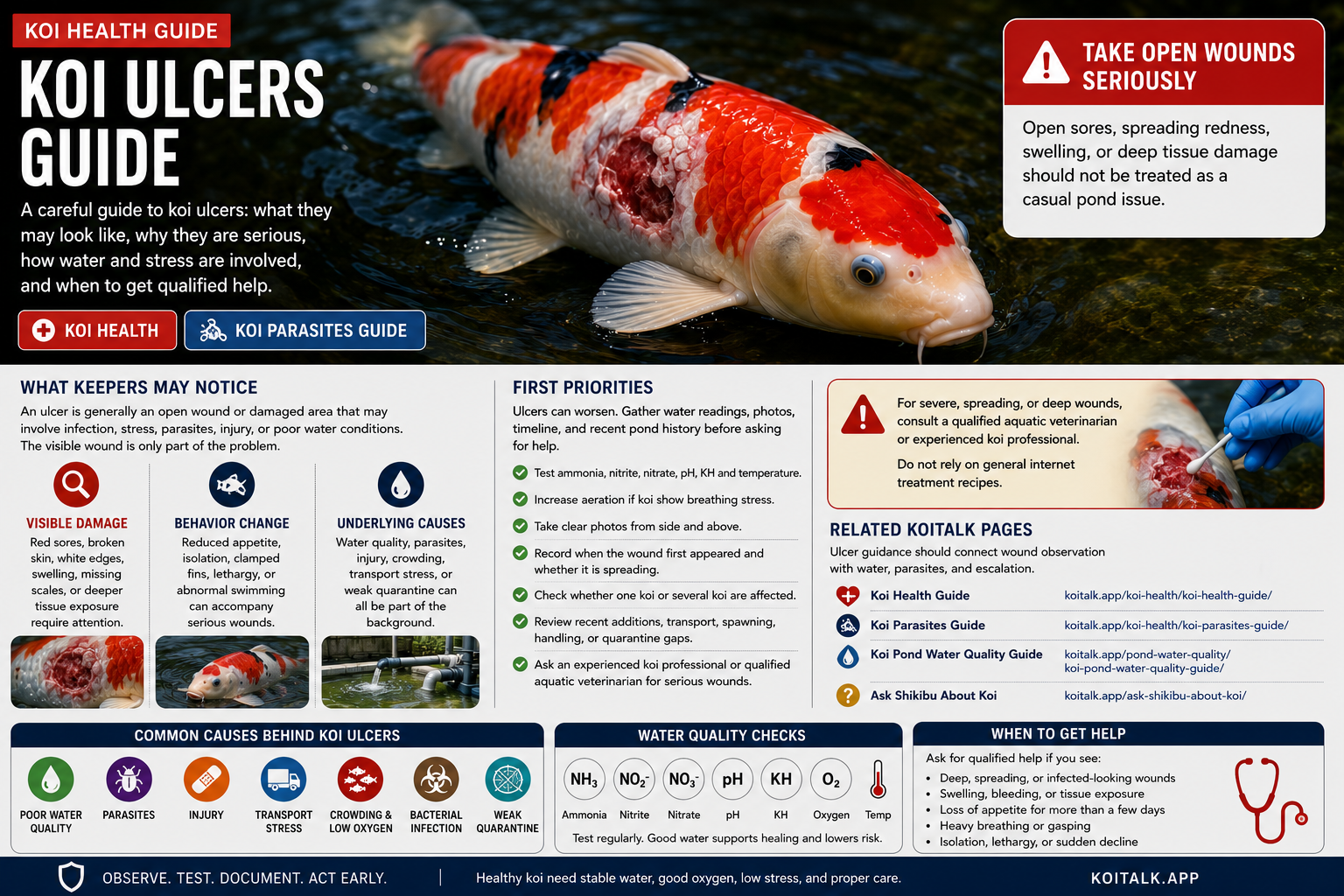
Koi Ulcers Guide
This koi ulcers guide explains what koi ulcers may look like, why open wounds are serious, how water quality and stress are involved, and when qualified help is needed.
Why Koi Ulcers Are Serious
Koi ulcers are usually visible wounds or damaged areas that may involve infection, stress, parasites, injury, or poor water conditions. The wound itself is only part of the problem; the pond system and recent history matter too.
Visible Damage
Red sores, broken skin, white edges, swelling, missing scales, or deeper tissue exposure require careful attention.
Behavior Change
Reduced appetite, isolation, clamped fins, lethargy, abnormal swimming, or heavy breathing can accompany serious wounds.
Underlying Causes
Water quality, parasites, injury, crowding, transport stress, rough handling, or weak quarantine can all be part of the background.
Common Warning Signs of Koi Ulcers
This koi ulcers guide treats visible wounds as warning signs that need context. Record what you see, test the water, review recent pond changes, and seek help if the wound is severe, spreading, or deep.
Red Sores
Red, raw, or inflamed areas may suggest skin damage, infection, parasite irritation, injury, or stress-related breakdown.
Broken Skin
Open skin, missing scales, damaged tissue, or white wound edges should be taken seriously and monitored closely.
Swelling
Swelling around a wound can indicate deeper irritation or infection risk and should not be ignored.
Clamped Fins
Clamped fins can appear with pain, stress, poor water quality, parasites, or infection.
Isolation
A koi that separates from the group, stops feeding, or rests unusually may be seriously stressed.
Rapid Change
A wound that spreads quickly, deepens, or appears with breathing problems needs urgent attention.
First Priorities
Ulcers can worsen quickly. Gather useful information before asking for help, but do not delay if the koi is declining or the wound is severe.
- Test ammonia, nitrite, nitrate, pH, KH, and temperature.
- Increase aeration if koi show breathing stress.
- Take clear photos from the side and above if possible.
- Record when the wound first appeared and whether it is spreading.
- Check whether one koi or several koi are affected.
- Review recent additions, transport, spawning, handling, predator damage, or quarantine gaps.
- Ask an experienced koi professional or qualified aquatic veterinarian for serious wounds.
Koi Ulcers Guide to Water Quality Checks
Water quality problems can weaken koi, delay healing, and make wounds worse. Every koi ulcers guide should connect wound observation with pond testing before guessing at treatment.
Ammonia
Ammonia can irritate skin and gills, increasing stress and reducing a koi’s ability to recover.
Nitrite
Nitrite can create serious stress and should be checked whenever koi are weak, breathing poorly, or showing wounds.
pH and KH
Unstable pH can stress koi and complicate recovery. KH helps buffer pH and supports biological filtration.
Oxygen
Oxygen supports koi recovery and filter function. Warm water, crowding, and heavy feeding can increase oxygen demand.
Temperature
Temperature affects immune response, bacterial activity, feeding, and treatment decisions.
Filtration
Weak filtration allows waste to build up and can make koi more vulnerable to wound complications.
Possible Causes Behind Koi Ulcers
An ulcer can have more than one cause. The visible wound may be the result of several pressures acting together, so careful investigation matters.
- Poor water quality or unstable pond conditions.
- Parasite irritation leading to skin damage.
- Injury from sharp edges, rough handling, predators, or spawning.
- Transport stress or weak recovery after moving fish.
- Crowding, low oxygen, or high organic waste.
- Bacterial infection following skin damage.
- New fish introduced without enough quarantine or observation.
What Not to Do
Guesswork can make koi ulcers worse. Treat the wound, the fish, and the pond as connected parts of one problem.
- Do not ignore open wounds or spreading redness.
- Do not apply random treatments without understanding the cause.
- Do not mix multiple products in panic.
- Do not forget to test water before focusing only on the wound.
- Do not return a weak fish to poor conditions without correcting the pond problem.
- Do not delay professional help if the wound is deep, spreading, or affecting behavior.
When to Ask for Qualified Help
For severe, spreading, deep, infected-looking, or repeated wounds, consult a qualified aquatic veterinarian or experienced koi professional. Serious koi health problems should not be handled by general internet treatment recipes or guesswork alone.
Q&A: Koi Ulcers Guide
What does a koi ulcer look like?
A koi ulcer may look like a red sore, open wound, missing scales, swollen area, broken skin, white-edged wound, or deeper tissue damage.
Are koi ulcers serious?
Yes. Open wounds can worsen, become infected, and indicate deeper problems with water quality, parasites, injury, or stress.
What should I check first?
Test ammonia, nitrite, nitrate, pH, KH, and temperature. Also check oxygen, filtration, recent additions, quarantine, and behavior changes.
Can parasites cause ulcers?
Parasites can irritate skin and lead to damage that may become infected. Proper identification is important before treatment.
Should I treat koi ulcers myself?
Minor surface issues still require care and good water. Severe, deep, spreading, or infected-looking ulcers should be handled with qualified help.
When should I call a professional?
Ask for help if the wound is deep, spreading, swollen, repeatedly returning, or if the koi stops eating, isolates, gasps, or declines.
Further Reading
Ulcer guidance should connect wound observation with water quality, parasite investigation, quarantine, and responsible escalation.
Next Step
Use this koi ulcers guide to slow down, test the water, document the wound, review recent pond history, and ask for qualified help when the wound is serious.